Two Green Children Climbed Out of a Wolf Pit in Medieval Suffolk. They Said They Came From a Land Without Sun.
It was harvest time in a small village in Suffolk, sometime in the 1100s, and the reapers were out in the fields. Near the edge of the village were some very old pits, dug long before anyone could remember to trap wolves. Out of one of them, according to a monk who wrote it all down a few decades later, came two children: a boy and a girl, dressed in clothes of a strange color made from material nobody recognized. Their skin was green. The monk's phrase was "completely green in their persons."
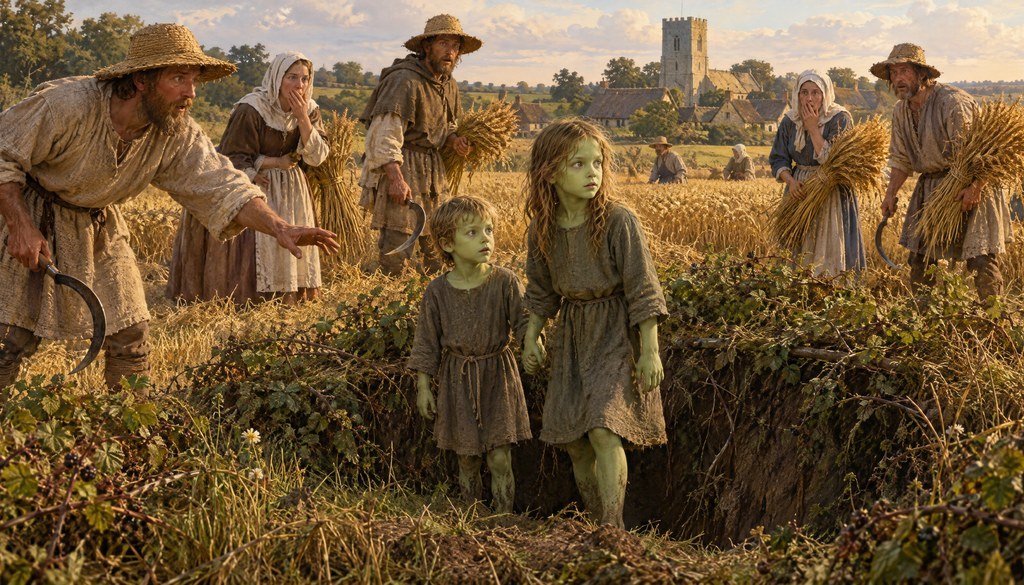
The reapers grabbed them and walked them into the village, and people came from all around to stare.
Two monks, one story
Almost everything we know comes from two medieval writers who never met the children and probably never read each other's work.
The first was William of Newburgh, a canon at Newburgh Priory in Yorkshire, who finished his History of English Affairs around 1189. He puts the event "during the reign of king Stephen," which means somewhere between 1135 and 1154. He describes the village as four or five miles from the great abbey of St Edmund, near "very ancient cavities, called 'Wolfpittes.'" That village is Woolpit, whose name really does come from the Old English for a pit for trapping wolves. It was first written down in the 10th century as Wlpit.
The second writer was Ralph, abbot of the Cistercian monastery at Coggeshall in Essex, about 26 miles south of Woolpit. He told the story in his Chronicum Anglicanum, written in the 1220s. William said his information came from a number of trustworthy people he did not name. Ralph named his source: Sir Richard de Calne, a knight from Wykes, about six miles north of Woolpit, who took the children into his own household.
The two versions agree on the main points and part ways on a few details, which is roughly what you would expect from a story that traveled by word of mouth across England in the 12th century.
A diet of beans
The children would not eat. For several days they refused everything they were offered.
Then someone brought in beans freshly cut from the field, still on the stalk. William's account of what happened next is oddly specific. The children seized the plants eagerly, then broke open the stalks looking for something inside, found nothing "in the hollow of the stalk," and "wept bitterly." Finally a bystander thought to split open the pods and hand them the beans themselves. The children "ate them with pleasure," and lived on beans alone for months, until they learned to eat bread.
Slowly their skin lost its green tint, which William put down to "the natural effect of our food." They began to look like any other Suffolk children, and they learned English.
The boy, and the girl who stayed
Local people decided the children should be baptized, and they were. The boy, who seemed to be the younger of the two, had always been the sicklier. William says he died a little while after the baptism; some modern retellings have him dying just before it.
His sister lived. William says she grew up healthy and "differed not in the least from the women of our own country." She married a man from Lynn (King's Lynn, in Norfolk, about 40 miles away) and was said to be still living there a few years before William wrote. Ralph adds that she worked for many years as a servant in Richard de Calne's house, and he describes her as "very wanton and impudent," which tells us a little about her and possibly more about Ralph.
St Martin's Land
The best part of the story is what the girl said once she could speak English. Asked where she came from, she answered, in William's version: "We are inhabitants of the land of St. Martin."
It was a Christian country, she said, with churches. But it had no proper sun. "The sun does not rise upon our countrymen," she told them; they lived in a permanent dim light like the twilight before sunrise or after sunset. Not far away, across "a very considerable river," lay a bright, "luminous country," separate from their own.
Neither child knew how they had got to Woolpit. William says they had been tending their father's flocks when they heard a loud sound, like the bells of St Edmund's Abbey ringing, and suddenly found themselves among the reapers. Ralph's version is more down to earth, or rather under it. The children had followed their father's cattle into a cave, got lost, heard the sound of bells, and followed it until they came out into the open. Ralph also adds that everything in their homeland was green.
William, it should be said, did not want to believe any of this. He wrote that he had "long been in doubt concerning the matter" and had thought it "ridiculous" to credit something with no rational basis. In the end he was "so overwhelmed by the weight of so many and such competent witnesses" that he felt he had to record it anyway. "Let every one say as he pleases," he added.
The case for sick, lost children
People have been arguing about the green children ever since. The antiquarian William Camden thought it was a hoax in 1586. Robert Burton, in 1621, took it as true. The historian Charles Oman, centuries later, suspected "some story of drugging and kidnapping."
The most popular modern explanation was put forward by Paul Harris in 1998. Flemish immigrants, many of them cloth workers, had settled in eastern England in the early 1100s and had a rough time after Henry II became king in 1154. In 1173 a rebel army that included Flemish mercenaries was beaten at the battle of Fornham, beside the River Lark near Bury St Edmunds. Harris suggested the children were Flemish orphans who fled into the forest and wandered until they reached Woolpit. Their "unknown language" would be Flemish, their odd clothes Flemish clothes, and "St Martin's Land" the village of Fornham St Martin, just north of Bury, with the river to cross nearby.
For the green skin, Harris pointed to hypochromic anemia, also called chlorosis or "green sickness," a condition linked to poor diet that can give the skin a greenish tinge. The literary historian Derek Brewer came to a similar conclusion: very small children who had strayed from a forest village, suffering from a deficiency disease.
The writer Brian Haughton called Harris's idea the most widely accepted explanation, and then said it "does not stand up in many respects." An educated knight like Richard de Calne would probably have recognized Flemish when he heard it. There is a dating problem too: William places the event under King Stephen, and the battle of Fornham came nearly 20 years after Stephen died. The historian John Clark was unconvinced by both the Flemish theory and the green sickness. Another scholar, Madej, pointed out that if poor diet turned children green, a fair share of medieval England would have been green too. The children's shade, he argued, must have been something people had never seen before.
Fairies, aliens and harvest rites
The less sensible explanations are more fun.
Folklorists note that the story reads a lot like an Otherworld tale: children from an underground land, a passage through a cave, a mysterious sound, and food that matters. The folklorist K. M. Briggs pointed out that beans were traditionally the food of the dead. John Clark thought that was going too far, though he agreed beans are linked with the dead in many cultures. Gerald of Wales, writing around the same time, tells a similar tale of a truant boy led through an underground passage to a land of small people.
Other scholars have read it as something else in disguise. Martin Walsh saw it as "a garbled account of an atavistic harvest ritual" tied to St Martin. Jeffrey Jerome Cohen saw a story about racial difference, a way for William to write indirectly about the Welsh and other native Britons. Clark doubted the harvest-ritual reading too.
And then there is Duncan Lunan. In a 1996 article for the science fiction magazine Analog, he proposed that the children had been accidentally transported from another planet by a faulty "matter transmitter." Their world, he suggested, might keep one face to its sun, leaving a narrow strip of permanent twilight where life could survive, and their green color came from eating the alien crops grown there. Lunan also did genealogical research on the de Calne family and concluded the girl was called Agnes and married a royal official named Richard Barre. That identification is his, and the chronicles do not name her.
There is even a later folk version that turns it into a Babes in the Wood story: the children were poisoned with arsenic by a wicked uncle and left to die in the woods (often said to be Wayland Wood or Thetford Forest), then stumbled their way to the Woolpit pits.
Woolpit today
Woolpit has embraced its strangest residents. Since 1977 the village sign has shown the two green children. In 1978 the writer Bob Roberts reported, "I was told there are still people in Woolpit who are 'descended from the green children.'" If that is true, they have kept quiet about it.
The story has had a long life in books, too. The 17th-century bishop Francis Godwin borrowed from William for The Man in the Moone, one of the earliest English space stories. Herbert Read built his only novel, The Green Child, around it, and Kevin Crossley-Holland wrote the libretto for a community opera about it in 1990.
The question left hanging
Strip away the aliens and the fairies and you still have a stubborn little core. Two writers, working separately and from different sources, set down the same strange details: green skin, unknown clothes, an unknown language, beans eaten straight from the pod, a twilight country called St Martin's Land, and a girl who grew up and married in Lynn. William, a careful and skeptical historian, admitted he could not explain it, and nobody has done much better in the 800-odd years since.
So who were they: two frightened Flemish orphans, a folk tale that got written down as news, or visitors from somewhere the sun never quite rises?
Sources & further reading
- William of Newburgh, History of English Affairs, Book 1, Chapter 27, "Of the Green Children," Fordham University Internet Medieval Sourcebook, William of Newburgh: Book One
- Wikipedia, Green children of Woolpit
- WikiJournal Preprints, Green children of Woolpit
- Wikipedia, Woolpit
- Mental Floss, The Mystery of the Green Children of Woolpit
- Clark, John (2006). "'Small, Vulnerable ETs': The Green Children of Woolpit." Science Fiction Studies 33(2), pp. 209-229.
- Harris, Paul (1998). "The Green Children of Woolpit: A 12th Century Mystery and its Possible Solution." Fortean Studies 4.
- Haughton, Brian (2007). Hidden History: Lost Civilizations, Secret Knowledge, and Ancient Mysteries. New Page Books.