A Lake in Cameroon Let Out One Breath in 1986. By Morning, Nearly 1,800 People Were Dead.
On the morning of August 22, 1986, a man named Joseph Nkwain came to in Subum, a village in the hills of northwest Cameroon. The night before, he had lost the ability to speak and then passed out. Now he found that his daughter was already dead. Outside, the village looked the way it always did: the huts were standing, the gardens were fine, nothing was burned or broken. But the cattle were lying in the fields, and so were the birds, and so, in house after house, were his neighbors.
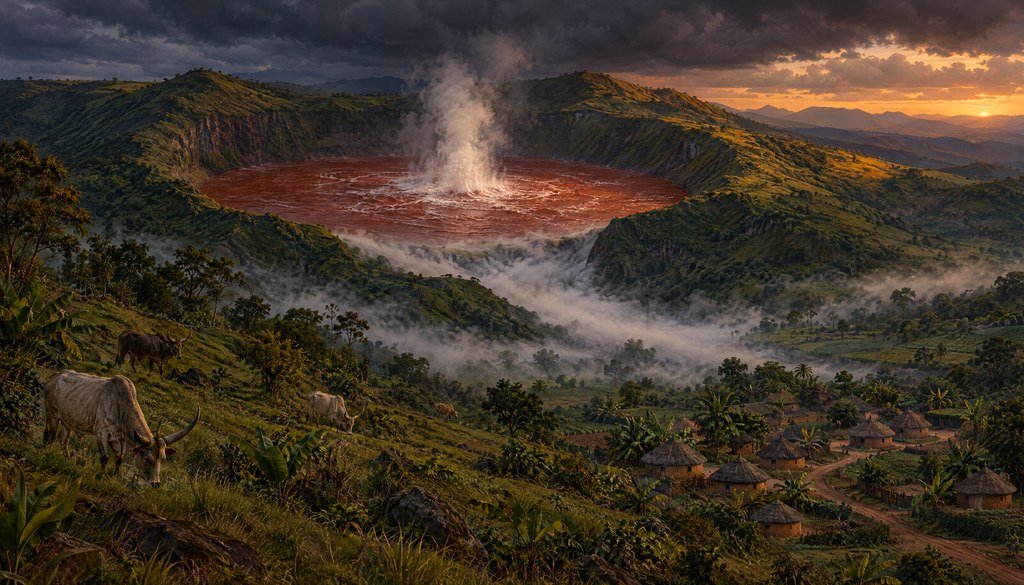
The killer had come from the lake up the valley. Lake Nyos had, in effect, exhaled. Overnight it released a huge cloud of carbon dioxide that rolled down the hillsides and pooled in the valleys where people were asleep. The usual death toll given is 1,746 people, plus about 3,500 cattle, along with birds and insects. Reporters who reached the area said it looked like the aftermath of a neutron bomb.
It's one of only two events of its kind ever recorded, and the other one happened two years earlier, about 100 km (60 miles) away.
A pretty lake on top of a problem
Lake Nyos sits about 315 km (196 miles) northwest of Yaoundé, Cameroon's capital, high on the flank of an inactive volcano in the Oku Volcanic Field. It's a maar, a roughly circular crater left behind when rising magma hit groundwater and the whole thing blew. The lake is small: about 2 km long and 1.2 km wide, with a surface of roughly 1.6 square kilometers. It is also deep, about 208 meters (682 feet) at its deepest.
Its age is disputed. A NASA Earth Observatory caption says the crater formed about 400 years ago, while a 2017 dating study puts it at no more than 12,000 years old. Either way, the volcano itself is quiet, but the plumbing underneath isn't. Deep below the lake, roughly 80 km down, a pocket of magma leaks carbon dioxide upward through the rock, and the gas seeps into the lake's bottom water.
Cold water under heavy pressure can hold an enormous amount of dissolved gas, the same way a sealed bottle of soda holds its fizz. Lake Nyos is also unusually still. Its layers don't mix much, so the deep water just sat at the bottom, year after year, soaking up more and more CO2. By 1986 the lake was, in practical terms, a shaken soda bottle 200 meters deep, with a lid made of nothing but water.
Downhill from the lake, a dirt road ran through a string of villages: Cha, Nyos, Munji, Djingbe and Subum. Thursday, August 21, was a market day, and according to one account most people went to bed early.
The night the lake turned over
At around 9:30 that evening, people heard something. The Scientific American account describes it as a strange sound, like a distant explosion. Some survivors later said they smelled gunpowder or rotten eggs, although the only gas scientists actually found in the lake water was carbon dioxide (which, oddly, can make people perceive a sulfur smell at non-lethal doses).
Something had disturbed the deep, gas-heavy water and pushed some of it upward. As it rose, the pressure on it dropped, and the dissolved CO2 started coming out as bubbles. The bubbles made the water lighter, so it rose faster, which released more bubbles, which made it rise faster still. Once that loop started, it fed itself. One research team described the whole lake overturning "through an ascending column of rising and expanding bubbles."
Scientists who later studied the shoreline concluded that a fountain of water and foam shot about 100 meters (330 feet) into the air. A wave at least 25 meters (82 feet) high swept across one shore and knocked down trees. The lake level dropped by about a meter. Within hours the water had turned a deep rusty red, because iron-rich water from the bottom had been dragged to the surface and oxidized in the air.
Then the gas came out. Estimates of how much vary a lot, from about 100,000 to 300,000 tonnes of CO2 in most sources, up to 1.6 million tonnes in others.
A cloud that flowed like water
Carbon dioxide is about 50 percent heavier than air, so the cloud didn't drift off into the sky. It sank.
The cloud rose out of the lake at close to 100 km/h, then spilled over the crater's northern lip and did what a heavy liquid does: it ran downhill. It poured into the valley that runs from Cha to Subum, then split down two branching valleys to the north. On its way down it moved at an estimated 20 to 50 km/h (one NASA caption says over 100 km/h; sources disagree). The cloud was about 50 meters thick, a ground-hugging river of invisible gas, and it stayed dense enough to kill for roughly 23 to 25 km (about 15 miles) from the lake.
There's no warning with CO2. It has no color, and at high concentration it simply takes the place of the oxygen in the air. People who breathed it lost consciousness quickly, often where they sat or lay. Pathologists and interviews later confirmed that the deaths were from asphyxiation. Doctors who treated survivors found skin sores that at first looked like chemical burns but turned out to be pressure sores from lying unconscious for hours.
About 4,000 people fled the area afterward, and 845 were treated for injuries, some of them in hospitals as far away as Yaoundé.
Joseph Nkwain was one of the lucky ones. After finding his daughter, he made it out by motorcycle to the town of Wum.
It had happened before
Two years earlier, on August 15, 1984, Lake Monoun, another crater lake in western Cameroon, released a gas cloud that killed 37 people. Nyos was the same kind of event, about 47 times deadlier.
After Nyos, international scientific teams flew in, including U.S. Geological Survey scientists. A 1987 paper in Science by George Kling and colleagues became the standard account. The phenomenon now has a name, a limnic eruption, from the Greek word for lake. So far, Monoun and Nyos are the only two ever recorded.
So what set it off?
This is the part that's still open. Everyone agrees on the mechanism: deep water saturated with CO2 got pushed upward, and the bubbling chain reaction did the rest. What nobody has pinned down is the push.
Most geologists suspect a landslide: rock sliding into the lake could have shoved surface water down and stirred up the deep layer. Some researchers think a small volcanic eruption on the lake bed did it, which would make Nyos less of a lake disaster and more of a volcanic one. Others point to cold rain falling on one side of the lake, chilling the surface water until it sank and disturbed the layers below. An earthquake is possible in principle but considered unlikely, because no survivors reported feeling any tremors. And one account suggests the trigger could have been as trivial as a slight breeze.
There's also a more unsettling view. A team led by Michel Halbwachs argued that a lake this saturated doesn't need an outside trigger at all. If enough gas builds up, the lake can tip over on its own. That isn't the consensus, but if it's right, the cause of the disaster was simply time.
Fixing a lake with a straw
If the problem is a soda bottle under pressure, the fix is to let the fizz out slowly. That is, more or less, what engineers did.
Halbwachs and a French-Cameroonian team worked out a simple design. Run a pipe from the deep water up to the surface and pump some water into it to get it started. As the water rises in the pipe, the pressure drops, bubbles form, and the bubbly water becomes lighter and rises on its own. After that, no pump is needed. The lake powers its own degassing, shooting a fountain of water and CO2 into the air above the surface where the gas can disperse harmlessly.
The first permanent pipe went into Lake Nyos in January 2001, with funding from the U.S. Office of Foreign Disaster Assistance. Two more followed in 2011. By 2019, the degassing had reached a steady state, and a single pipe was judged able to keep the lake safe indefinitely without any outside power. Lake Monoun got its own pipes, one in 2003 and two more in 2006, and is now considered safe.
It's not maintenance-free. The slightly acidic water corrodes pipes and equipment, and there's a second worry: the lake's natural dam. The wall of volcanic rock holding the water in is only about 45 meters wide at its narrowest. A United Nations team that inspected it in 2005 found it weakening and suggested it could breach within 10 to 20 years. If it failed, as much as 50 million cubic meters of water could flood down into northwest Cameroon and across the border into Nigeria. A geologist at Cameroon's Institute of Mining and Geological Research acknowledged the weakness but said there was no immediate threat.
The much, much bigger lake
There's a third lake with dissolved gas in its depths, and it's a lot bigger.
Lake Kivu sits on the border between Rwanda and the Democratic Republic of the Congo. It's somewhere between 1,700 and 2,000 times bigger than Lake Nyos, depending on which source you read, and it holds both carbon dioxide and methane in its deep water. More than two million people live along its shores. Mount Nyiragongo, a volcano close to the lake, erupted in 2002 and again in 2021. In 2002, lava flowed into the lake but didn't reach the deep layer.
Studies around 2005 suggested Kivu was dangerously saturated. A later study, released in 2020, found flaws in that earlier work and no sign that the risk is rising. In the meantime, Rwanda has been piping up methane from the deep water since 2010 to generate electricity, which also removes some of the gas. It's a power plant with a very useful side effect.
The question left hanging
The strangest thing about Lake Nyos is how ordinary it looks now. It's a quiet blue lake in green hills, with a white plume of water spurting up in the middle like a garden fountain. People have been returning to resettle the area.
Still, nobody can say for certain what made it turn over on that particular Thursday night in 1986. Was it a landslide, a rainstorm, a hiccup from the volcano below, or just a lake that had held its breath as long as it could? And if it was the last one, how many other quiet lakes out there are holding theirs?
Sources & further reading
- Wikipedia, Lake Nyos disaster
- Wikipedia, Lake Nyos
- Wikipedia, Limnic eruption
- Scientific American (History of Geology blog), "August 21, 1986: The Lake Nyos Catastrophe"
- NASA Earth Observatory, "Lake Nyos, Cameroon"
- Kling, G. W., et al. (1987). "The 1986 Lake Nyos Gas Disaster in Cameroon, West Africa." Science, 236(4798), 169-175.