A Talking Mongoose Moved Into a Farmhouse on the Isle of Man. Nobody Ever Proved He Wasn't There.
In September 1931, the Irving family started hearing things behind the wooden panels of their farmhouse on the Isle of Man. First came scratching and rustling. Then barking, spitting and growling, like an animal working out which noises it could make. By the end of the year, according to the family, the thing in the walls had started to talk.
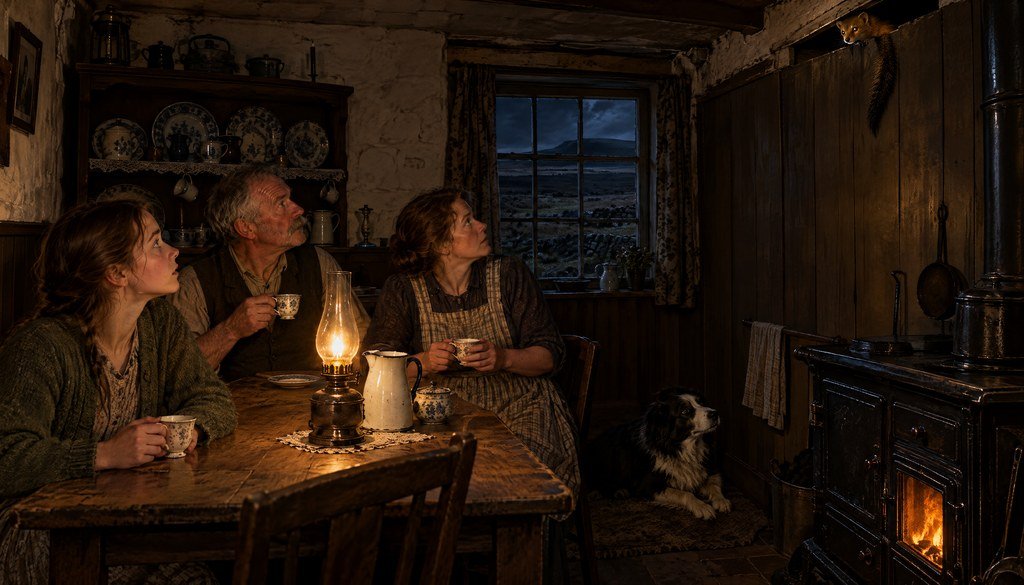
It said it was a mongoose. It said it had been born in India in 1852, which would have made it nearly 80. It said its name was Gef (pronounced "Jeff"), and over the next several years it would gossip about the neighbors, throw things, demand bananas, threaten the family, sing, swear, and attract newspaper reporters, psychic investigators, a celebrated ghost hunter and, eventually, a slander case in London's High Court.
Nobody outside the family ever got a clear look at it.
The loneliest farm on the island
The farm was called Doarlish Cashen, or Cashen's Gap in English, up in the hills above the village of Dalby on the Isle of Man's west coast. It was remote even by island standards, a lonely hill farm a long walk from anyone else.
James Irving had bought it in 1916 for £310, after his business selling pianos and organs collapsed during the First World War. He became a sheep farmer more or less by necessity. He lived there with his wife Margaret, a dressmaker, and their youngest child, Voirrey, who was born in 1918 and was about 13 when the noises began.
The farmhouse walls were double, with wooden panelling set in front of the stone and a hollow gap between the two. Harry Price, who later investigated, called the whole house "one great speaking-tube."
Meet Gef
The Irvings said they first glimpsed the creature in October 1931. James described it as about the size of a rat, yellowish, with a big bushy tail. Over the following weeks, the sounds from the walls turned into baby talk, then words, then full sentences. The family first called it "Jack" before it gave them its proper name.
Once Gef could talk, he did not stop. Depending on which account you read, he:
- called himself "an extra extra clever mongoose" and, on other days, an "earthbound spirit" or "a ghost in the form of a weasel"
- ate bananas, oranges, chocolate, biscuits and bacon (leaving the fat)
- warned the family when visitors or strange dogs were coming, and woke people who overslept
- turned off the stove if the fire was left burning, which is more than most houseguests do
- killed rabbits and left them for the family
- picked up gossip around the island and came home with it
- claimed to speak several languages, including Russian and Spanish, though investigators noted his "Flemish" was really German and his Hindi ran to a few words like "maharajah"
He was not always pleasant company. He insulted people who doubted him and went silent around them. One widely repeated line has him telling the family, "I could kill you all, but I won't." For several months he threatened to harm Voirrey in her sleep, and she moved into her parents' bedroom.
And yet the family seems to have treated him mostly like a slightly alarming pet. Margaret was his favorite. He reportedly called her the "witch-woman."
The newspapers arrive
The story got out in January 1932, when the Manchester Daily Dispatch ran it, and the Isle of Man Examiner followed in February. Reporters walked up the hill to Doarlish Cashen hoping to hear Gef for themselves.
The results were not encouraging for the mongoose. The Dispatch reporter came away suspecting Voirrey was behind the voice, possibly as a ventriloquist's joke. An Examiner reporter said he actually caught her making the noises, while her father insisted the sound was coming from somewhere else in the room.
There were outside witnesses of a sort. A family friend, Arthur Morrison, said Gef spoke to him from under his bed and that he saw a pair of yellow eyes. Two local teenagers, Will Cubbon and Henry Hall, said they saw a yellow animal with a black spot on its tail in Cubbon's yard. None of that amounts to much, but it was more than most hoaxes get.
The ghost hunter and the BBC editor
By the mid-1930s Gef had caught the attention of Harry Price, the most famous psychical researcher in Britain. In July 1935 he went to the farm with Richard Lambert, the editor of the BBC's magazine The Listener.
Gef, naturally, refused to say a word while they were there.
What Price did get was physical evidence the family had collected. Gef had supposedly supplied some of his own fur, and Voirrey had pressed his paws and teeth into plasticine. The fur went (via the biologist Julian Huxley) to the naturalist F. Martin Duncan, who identified it as dog hair. Price suspected it came from the Irvings' sheepdog, Mona. Reginald Pocock of the Natural History Museum looked at the paw and tooth prints and couldn't match them to any known animal. One, he said, could conceivably have been made by a dog. None came from a mongoose. Other accounts say the prints lacked the texture of real skin and may have been made with a stick.
There was also a photograph or two. The best known shows a blurry pale shape on a fence post that could be almost anything, including a cat.
Price and Lambert wrote it all up in The Haunting of Cashen's Gap (1936). The book is careful and fairly dry. It doesn't call the Irvings frauds, and Price said he found no proof of fraud, but it does list the ways Gef resembled a teenage girl: a sweet tooth for biscuits, cakes and sweets, and a keen interest in cars and aeroplanes.
The Mongoose Case
The book's most expensive consequence came the following year, in a courtroom.
Sir Cecil Levita, a retired colonel, told a friend that Lambert wasn't fit to sit on the board of the British Film Institute, because a man who believed in a talking mongoose must be "off his head." Word got back to Lambert. His bosses at the BBC reportedly told him to let it go. He sued for slander instead.
He won, and the damages were huge for the time, about £7,500 (sources give slightly different figures and dates for the trial). The newspapers called it "the Mongoose Case." Gef never proved he existed, though he did cost a retired colonel a small fortune.
The investigator who believed (for a while)
In 1937, Nandor Fodor of the International Institute for Psychical Research spent about a week at the farm. Gef never spoke to him. Fodor did report that stones were thrown and a door banged.
Even so, Fodor came away convinced the Irvings were not lying on purpose. He interviewed witnesses, some of them hostile, and half-seriously floated the idea that Gef might be a real mongoose that had learned to talk. There was a faint logic to it: a local farmer was said to have released mongooses on the island some 20 years earlier to deal with pests. (The details of that release, including the year and whether the targets were rats or rabbits, vary between sources, and I couldn't confirm them.)
Decades later, Fodor changed his mind. In the 1950s he argued that Gef was a "split-off part" of James Irving's personality, a lonely, frustrated man's alter ego talking back to him through the walls.
After Gef
Gef's visits seem to have tapered off in the late 1930s. Voirrey left home in 1939 to do wartime factory work. James Irving died in 1945, and Margaret sold the farm, reportedly at a loss because of its reputation.
A few years later (sources say 1946 or 1947), the new owner, Leslie Graham, shot a black-and-white, polecat-like animal near the house and announced that he'd killed Gef. Voirrey, shown the body, said it was not Gef: wrong color and far too big. Graham, for his part, reported that the animal had not said anything to him.
Voirrey spent the rest of her life trying to get away from the story. In a 1970 interview with the journalist Walter McGraw she said Gef had been "very detrimental" to her life, but she maintained she had not made him up. When filmmaker Brian Catling tracked her down near Cheltenham in 1996, she refused to talk about Gef at all. She died in 2005.
So what was Gef?
Here are the theories, roughly from most to least popular.
Voirrey
A clever, bored, isolated teenager with a talent for voices, a house with hollow walls, and parents willing (or wanting) to believe. The skeptic Joe Nickell points to ventriloquism and simple tricks, amplified by family, reporters and believers. The media historian Jeffrey Sconce suggests Gef was something like an imaginary companion that got out of hand. The trouble is that Voirrey denied it for the rest of her life, long after there was anything to gain.
James
This was Fodor's later idea: Gef as the voice of a disappointed man stuck on a failing farm. Gef supposedly found James more interesting than Voirrey as the years went on.
The whole family
Some islanders believed the Irvings were in on it together, perhaps with Margaret and Voirrey hoping to make the farm unbearable enough to leave.
An actual animal
Maybe there really was a small creature living in the walls, a feral mongoose or a weasel, and the talking got added by people who wanted it to talk.
Exactly what he said he was
A clever, cranky, 80-year-old Indian mongoose with a taste for bananas and gossip. Nobody has ever produced any evidence for this one, but nobody has managed to take it off the table either.
Christopher Josiffe, a librarian at Senate House Library in London (which holds James Irving's diaries in Harry Price's archive), spent seven years researching the case for his 2017 book Gef!. He doesn't settle it. He leaves open who was hoaxing whom, and whether anyone was hoaxing at all.
The question left hanging
Reporters and ghost hunters climbed that hill for years, and between them they came home with some dog hair, a blurry photo and a lot of silence. The one person who could have ended the argument was Voirrey, and she spent the rest of her life saying she didn't do it.
If Voirrey made Gef up, why did she keep denying it for more than 70 years, long after anyone was paying attention? And if she didn't, who was talking in the walls?
Sources & further reading
- Wikipedia, Gef
- Bee Wilson, London Review of Books, "I am the fifth dimension" (review of Christopher Josiffe's Gef!)
- Mental Floss, "The Strange Story of Gef the Talking Mongoose"
- Encyclopedia.com, "Cashen's Gap"
- Mysterious Britain & Ireland, "Gef, The Talking Mongoose"
- Price, Harry, and R. S. Lambert (1936). The Haunting of Cashen's Gap: A Modern "Miracle" Investigated.
- Josiffe, Christopher (2017). Gef! The Strange Tale of an Extra Special Talking Mongoose. Strange Attractor Press.