The Day It Rained Meat in Kentucky (and the Jar That Still Holds a Piece)
Mrs. Crouch was making soap in her yard in Bath County, Kentucky, on Friday, March 3, 1876, when the meat started falling. "There was a light wind coming from the west," she told reporters afterward, "but the sky was clear and the sun was shining brightly." Then, with no warning at all, pieces of raw flesh came down around her. Some were small shreds. Others were the size of her hand. She said they landed "with a snapping-like noise when it struck."
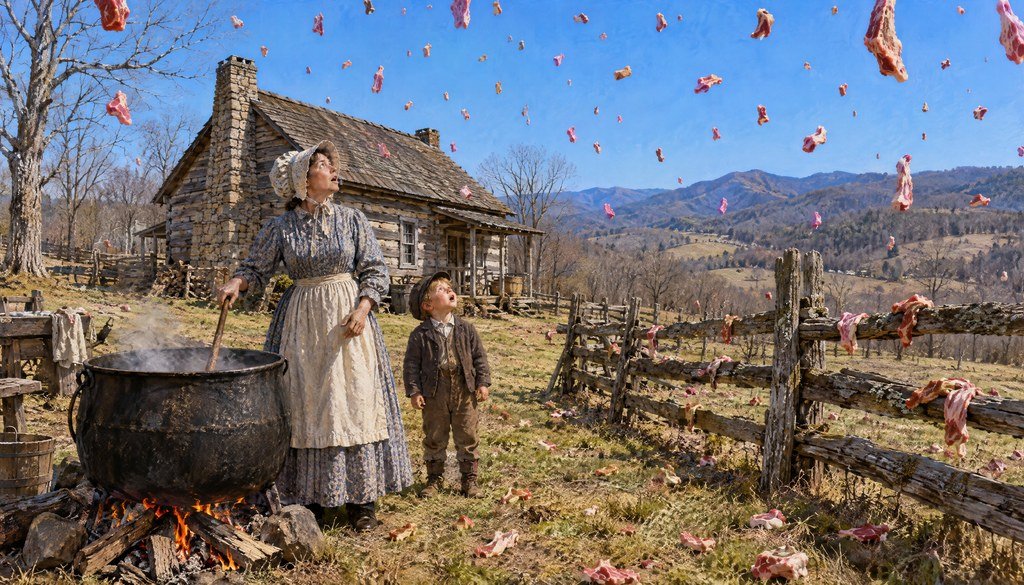
The shower lasted only a few minutes. When it was over, meat lay across a patch of the Crouch farm roughly 100 yards long and 50 yards wide, stuck to the fence and scattered over the ground. Accounts say there was enough of it to fill a horse-drawn wagon. Within days the story was in The New York Times, and within months chemists and microscopists in three states were arguing over what it was. They never settled it, and a little of the evidence is still floating in a jar in Lexington.
A farm near Olympia Springs
The Crouch farm belonged to Allen Crouch and his wife, Rebecca, and sat about three miles south of Olympia Springs. Mrs. Crouch was outside with her grandson when it happened.
Her own account puts the time "between 11 and 12 o'clock," and says she was "not more than forty steps from the house." (A Transylvania University project page about the event gives 2 p.m. instead. Her version, being hers, gets my vote.) She said she was "impressed with the conviction that it was either a miracle or a warning," and she wasn't the only one in the house who thought it might be a sign from God.
The largest piece she saw, she said, "was as long as my hand and about half an inch wide." It "looked gristly, as if it had been torn from the throat of some animal." Other pieces were shreds she described as "light as a snowflake." Most of what neighbors found later was in chunks about two inches square, with at least one about four inches across.
The neighbors come to look (and taste)
The next day a man named Harrison Gill visited the farm and found the meat still clinging to fences and lying on the ground. It had been fresh when it fell, but a night outdoors had left it spoiled and dried. The New York Times, reporting on March 10, described Gill's credibility as "unquestionable," which is the kind of thing a newspaper says when it knows readers are about to laugh.
People did what people do with a mystery meat: they argued about it, and a couple of them ate it. Two men who tasted it said it was "either mutton or venison." A local hunter said it was bear, citing "that uncommonly greasy feel." A butcher reportedly said it looked like mutton but tasted like no meat, fish or fowl he knew, and that "the smell was a new one."
Kurt Gohde, the Transylvania University art professor who has spent more than 20 years on this story, has said people in the area likely ate a fair amount of it.
Specimens in the mail
Samples left Bath County fast. Pieces went to chemists and microscope enthusiasts in Kentucky, Ohio and New York. The Transylvania project page says some were gathered by a group of the university's faculty, and that a Lexington man named Alexander Tenney Parker, a formerly enslaved head of household, collected samples and shipped them around the country. A Captain J. M. Bent carried more to Louisville on March 10.
Then the experts got going, and they disagreed with each other in ways that are almost a comedy routine.
Five experts, five answers
Start with frog spawn. J. Lawrence Smith, a well-known chemist, first suggested in the Times that the stuff was dried spawn from frogs or some similar animal, carried up by wind and dropped. He later abandoned the idea.
Leopold Brandeis, writing in The Sanitarian that summer, announced that the "Kentucky Wonder" wasn't meat at all. It was Nostoc, a cyanobacterium that lies flat and dry on the ground and swells into a jelly when it rains, which can make it look as though it fell from the sky. He even gave it a species name. He also reported that it tasted like frog legs or spring chicken, so Brandeis apparently tasted his sample too. The problem, as the writer Charles Fort pointed out in 1919, is that it hadn't rained. Mrs. Crouch was very clear about the sunshine.
Allan McLane Hamilton, a physician, looked at samples under a microscope and reported in the Medical Record that they were lung tissue, from either a horse or a human infant, because, he wrote, the structure of the organ in those two cases is almost identical. That is not a sentence anyone in Bath County wanted to read.
Microscopists including Arthur Mead Edwards and J. W. S. Arnold found cartilage, lung tissue and striated muscle. Across seven samples from different sources, the tally came out to two lung, three muscle and two cartilage. Whatever it was, it was animal, and it wasn't all one kind of tissue.
Then there was Dr. L. D. Kastenbine, a chemist at Louisville College, who heated his sample over a Bunsen burner and reported in The Louisville Medical News that it smelled distinctly like rancid mutton suet, then like burned animal tissue. His explanation was the one that stuck, and he said he got it from an old Ohio farmer.
The vulture theory
Kastenbine's idea was this: a flock of vultures, flying high over the farm, threw up.
Kentucky has two species, the black vulture and the turkey vulture, and both are known to vomit, either to scare off a threat or to drop weight so they can take off in a hurry. The old farmer's observation, as Kastenbine passed it along, was that when one bird in a flock disgorges, the others tend to follow. Wind would do the rest, spreading half-digested carrion over a few acres of pasture.
It also explains the thing nobody else could: why the samples were a mixed bag of lung, muscle, cartilage and fat. Vultures eat whatever dead thing they find. A horse, a sheep and a deer could all end up in the same shower.
There's a timing detail that helps, too. According to Kentucky's Department of Fish and Wildlife, both species gather in big communal roosts from about October to March and usually head back to their nesting areas around mid-March. March 3 falls right at the end of roosting season, when the birds would be around in numbers.
In 2014, writer Bec Crew went through the case for Scientific American and came out calling projectile vulture vomit the most plausible answer. Gohde agrees. He has called it the only explanation "that feels possible."
The weak spots
Plausible isn't the same as proven, though, and the vulture theory has some holes.
A wagonload is a lot of meat. Even a large flock emptying its stomachs at once would have to be carrying an impressive lunch. None of the accounts I found mention anyone seeing birds overhead, though on a sunny day, with vultures riding thermals high enough, it's possible nobody looked up. And no one in 1876 reported that the meat smelled like stomach contents, which you might expect. (Then again, one grocer reportedly said the smell was like a dead body, so maybe they did and just described it differently.)
Then there were the less serious theories. The humorist William Livingston Alden suggested in print that the meat was cosmic debris from the inhabitants of exploded planets. Most modern readers take that as satire. Charles Fort, who collected stories of things falling from the sky, kept the Kentucky shower in his 1919 Book of the Damned as a case science couldn't wave away.
The jar in the museum
In 2004, Gohde was helping clear out old collections at Transylvania University in Lexington when he came across a small glass vial of tissue preserved in alcohol. Its faded label tied it to the 1876 shower. (Wikipedia gives the label as "Olympia Springs"; the university's project page gives it as "Meatrain of 1876." Possibly both are on there somewhere.) It's now kept at the Monroe Moosnick Medical and Science Museum on campus, and it's believed to be the last surviving sample.
Naturally, someone tried DNA. The university ran the tissue through its gene sequencer, but after well over a century in a jar the DNA strands were too short to give a conclusive result. Gohde told NPR in 2026 that it came out "closest to a goat," while admitting they still don't know what it is. That doesn't settle much, but goats and sheep are close relatives, and Kastenbine's nose said mutton.
The meat has had a busy retirement. In 2007, according to the Transylvania page, a taste lab made jellybeans meant to match its flavor profile. In August 2024, the Bath County History Museum borrowed the vial and brought it back home for a temporary exhibit, 148 years after it fell, before returning it to Lexington.
A festival, naturally
Bath County has fully embraced its weirdest day. For the 150th anniversary, in March 2026, hundreds of people showed up for a meat shower festival with a meatball toss, a bologna throw (thick slice, thrown like a Frisbee), and vendors selling "mystery-meat" chili. Mick Sullivan read his children's book about the shower at the library. A woman who believes she descends from the Crouch family told NPR the story was part of her family's oral history.
For the finale, Gohde's team had an airplane fly over a field and drop 1,876 individually wrapped pieces of beef jerky. That made it the second meat shower in Bath County in 150 years, and the first with a known cause.
The question left hanging
The vulture explanation is good. It accounts for the mixed tissue, the clear sky, the season and the local birds, and the people who've studied the case longest believe it. But no account mentions anyone seeing birds, the DNA won't commit, and the one thing that might settle it is a few grams of 150-year-old lung, muscle or gristle sealed in a jar.
So what do you think fell on the Crouch farm that morning: vulture vomit, something stranger, or a story that got bigger every time it was told?
Sources & further reading
- Wikipedia, Kentucky meat shower
- Scientific American, Bec Crew, "The Great Kentucky Meat Shower Mystery Unwound by Projectile Vulture Vomit" (2014)
- Mental Floss, "That Time It Rained Flesh in Kentucky"
- NPR / WEKU, Cheri Lawson, "Cloudy with a chance of meatballs? Kentucky marks the day meat fell from the sky" (2026)
- Louisville Public Media, "Kentucky meat shower 150th anniversary draws hundreds to Bath County" (2026)
- WYMT, "Chunk of history returns home 148 years after Kentucky meat shower" (2024)
- Transylvania University, Kentucky Meatrain project page
- Kentucky Department of Fish & Wildlife Resources, Vultures
- The New York Times, "Flesh Descending in a Shower" (March 10, 1876)