Scandium Walks Into a Valley
Most mystery lights come with a campfire legend and a blurry photo. Hessdalen comes with a shipping container full of instruments.
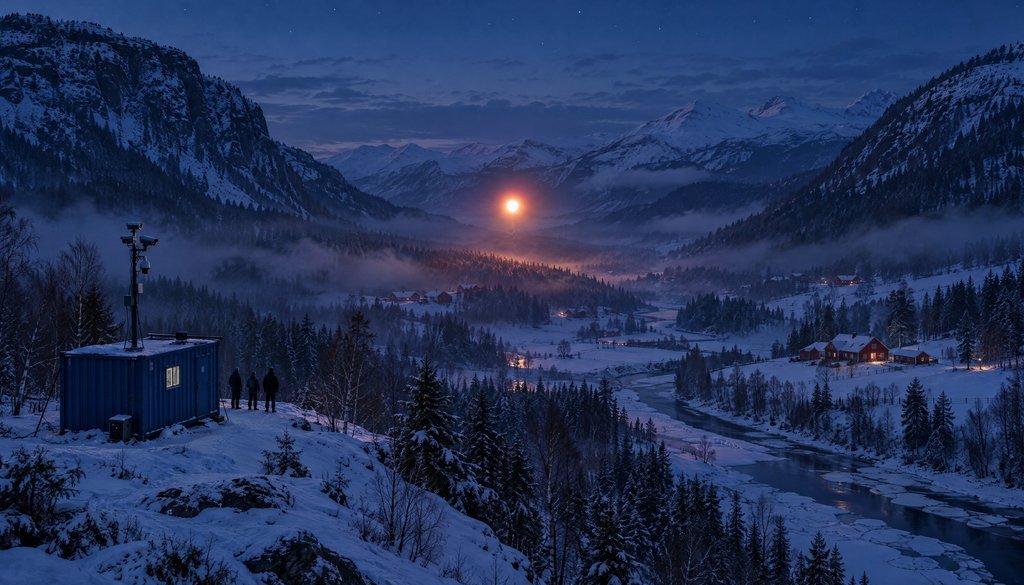
In a quiet valley in central Norway sits a blue metal box holding a magnetometer and a few cameras. Its only job is to watch the sky and wait for something weird to show up, which it has been doing since 1998, and the weird thing keeps showing up.
A burning fireball over the farm
The modern story starts in late 1981, when locals Åge and Rutt Marry Moe reported a "burning fireball" in the evening sky over the valley of Hessdalen, in Holtålen, Norway. By early 1982 the sightings had snowballed.
At the peak, from December 1981 to roughly mid-1984, people reported 15 to 20 sightings a week, and almost overnight tourists were showing up to stare at the sky. The lights were usually bright white, yellow or red. Some drifted lazily or hovered, and some reportedly took off at speeds that make a fighter jet look like it's idling. They lasted anywhere from a few seconds to well over an hour, and they showed up in daylight too, so you couldn't blame it all on the night.
Witnesses were mocked at first, which is the standard welcome package for anyone who reports a glowing orb. The sightings kept coming anyway, and eventually so did the scientists.
The valley that got instruments
Project Hessdalen started in 1983, run by the UFO groups UFO-Norge and UFO-Sverige. Erling Strand of Østfold University College, who coordinated the project's field investigation in the winter of 1984, became the name most tied to the serious scientific effort. The astronomer J. Allen Hynek, the former Project Blue Book adviser, sat on the project's advisory committee.
Then, on August 7, 1998, the Hessdalen Automatic Measurement Station switched on. Researchers call it the AMS, and since the equipment lives in a blue container, everyone else calls it the Blue Box. Inside are a magnetometer, two black-and-white TV cameras and one color camera.
Later teams, including Italian scientists working with Norwegian researchers, measured the lights across optical and radio frequencies. Their estimates are eye-catching: temperatures around 5,000 kelvin (roughly the surface of a sun-like star) and radiated power as high as 19 kilowatts. Take the exact numbers with a grain of salt. The 19-kilowatt figure comes from physicist Massimo Teodorani's 2004 survey, later measurements suggest the lights usually put out much less, and the various studies looked at different kinds of sightings. Whatever this is, though, it's hot and it's bright.
The punchline: scandium
When researchers analyzed the light's spectrum, Bjørn Gitle Hauge of Østfold University College presented the first public results at the 2007 Hessdalen conference. The light showed a continuous spectrum, the signature of a hot plasma or a glowing solid. It contained the stuff you'd expect: hydrogen, oxygen and nitrogen (in other words, air), plus silicon and iron (in other words, dust). It also contained scandium and titanium.
Hauge summed it up: "It's air and dust from Hessdalen that burns. But there is some other kind of element inside it: scandium."
Scandium is element 21. The Swedish chemist Lars Fredrik Nilson discovered it in 1879 and named it after Scandinavia. So a glowing mystery in a Norwegian valley turned out to contain an element named after the region it was found in. Scandium walked into Scandinavia, and the lights got a punchline.
Whether it's a real clue or a quirk of the valley's dust and mining history is what scientists are still arguing about.
The suspects
Nobody has a settled answer, but there's no shortage of suspects.
Researchers including Gerson Paiva and Carlton Taft proposed a dust-and-radon theory. Radioactive radon decay ionizes the air and the dust in it, and the charged dust organizes itself into glowing structures. In their computer simulations, the dust arranged itself into double helixes. Teodorani also reported, in 2004, elevated radioactivity on rocks near spots where lights had appeared. The trouble is that radon alone doesn't seem to supply the power the lights radiate.
The burning-dust theory follows the spectrum: dust that has been mined and scattered over the valley is burning in a way nobody fully understands. Norwegian newspapers once ran headlines declaring the mystery solved. Nobody can say what lights the fire, though, or why the glowing cloud holds its shape when a burning cloud should expand.
The valley also has plenty of quartz-rich rock, and quartz generates electric charge when squeezed, so maybe the Earth is giving the sky a static shock. That one is more hypothesis than finding.
The most delightfully weird idea came in 2014, when Jader Monari proposed that the valley works as a geological battery. Its two sides act as electrodes and the river Hesja acts as the electrolyte, producing charged gas bubbles that glow.
Some sightings have boring answers: planets, aircraft, car headlights, mirages. That's worth admitting, and it makes the leftovers more interesting, because the people measuring this aren't being fooled by a planet or a pair of headlights.
The oddest details
Project Hessdalen's 1984 technical report describes pointing a laser at a flashing light 9 times. Eight times, the light switched from a regular flash to a regular double flash, then went back to normal when the laser moved away.
Photojournalist Arne Wisth described standing with 30 to 40 other watchers, and he said of the lights, "These things did not make a sound." He also described seeing what looked like a bullet-shaped silhouette inside an oval glow.
Roughly 5% of sightings reportedly show geometric formations that none of the theories explain.
The lights are fading
The part that bugs me, in the best way, is the decline. By 2010, sightings had dropped from 15 to 20 a week to roughly 10 to 20 a year.
If the cause were purely geological, you'd expect the lights to keep going, and instead they faded. The source could be changing, with mining dust settling and conditions shifting. The early-'80s flurry may have had a lot to do with publicity and people looking up. Or the valley is just keeping its secrets to itself.
Most mysteries get less mysterious the harder you look at them. Hessdalen keeps piling up measurements (a temperature, a power output, a chemical fingerprint with scandium in it), and still nobody can say for sure what's burning. Science showed up with instruments and said, "Okay, we'll take it from here," and the valley kept glowing. The Blue Box is still running, and if the lights come back, it'll be ready.
Sources & further reading
- Wikipedia, Hessdalen lights and Hessdalen AMS
- Project Hessdalen, "Final technical report 1984", the primary account of the laser test
- Teodorani, M., "A long-term scientific survey of the Hessdalen phenomenon", Journal of Scientific Exploration, 2004
- "Optical spectrum analysis of the Hessdalen phenomenon", ResearchGate
- NaturPhilosophie, "Identifying the Unidentified: The Hessdalen Light Phenomenon"
- NaturPhilosophie, "Eliminating the Impossible: The Complex Electro-Chemistry Behind the Hessdalen Lights"