A Five-Masted Schooner Ran Aground Off Cape Hatteras With Every Sail Set. Her Crew Was Never Seen Again.
At 6:30 on the morning of January 31, 1921, a Coast Guard surfman named C. P. Brady was on lookout at the Cape Hatteras station on North Carolina's Outer Banks when he saw something odd out on Diamond Shoals. A big five-masted schooner was sitting hard aground on the outer edge of the shoals. Her sails were still set. Her lifeboats were gone. Nobody seemed to be moving on deck.
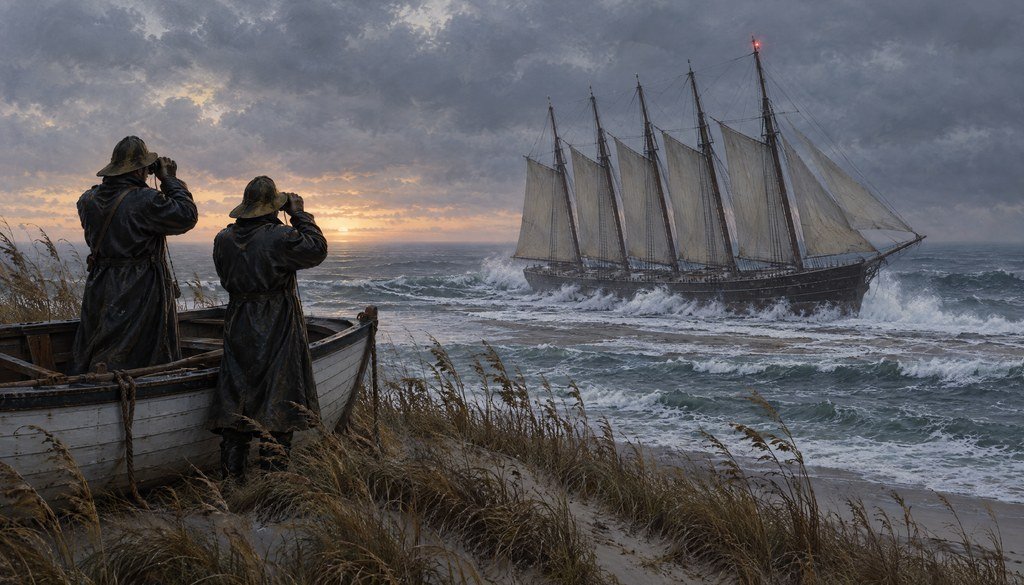
The seas were too rough for the surfboats, so for four days the ship just sat there in plain view while nobody could reach her. When people finally climbed aboard on February 4, they found food that looked ready for the next meal, a smashed steering wheel, and no sign of the captain or anyone else who had sailed with him.
More than a century later, nobody knows what happened to them.
A brand-new ship on her last big voyage
The Carroll A. Deering was barely two years old. The G. G. Deering Company built her in Bath, Maine, and launched her on April 4, 1919, naming her after the owner's son, Carroll Atwood Deering. She was 255 feet long with five masts, and she came along near the very end of the era of big wooden cargo schooners, just as steel and steam were taking over.
In the summer of 1920 she took on coal at Newport News, Virginia, bound for Rio de Janeiro. Her first captain on that trip was William H. Merritt, a World War I veteran, with his son Sewall as first mate. Not long after the ship cleared the Virginia Capes, Merritt fell seriously ill. The Deering put in at Lewes, Delaware, where Merritt and his son went ashore.
The replacement was Willis B. Wormell, a 66-year-old captain who had retired and came back for the job. His new first mate was Charles B. McLellan. The ship left on September 8, 1920, made Rio without trouble, and delivered her coal.
Trouble in Barbados
The Deering left Rio on December 2 and stopped at Barbados for supplies. By several accounts, Wormell and McLellan did not get along, and in Barbados McLellan was arrested while drunk. Wormell bailed him out anyway, and on January 9, 1921, the ship sailed for Hampton Roads, Virginia.
So the ship headed north with a captain and first mate who disliked each other, on a course that ran along one of the most dangerous stretches of coast in the Atlantic. That feud comes back later.
The man with the megaphone
Late in January, the Deering sailed past the Cape Lookout Lightship off North Carolina. Sources disagree on the exact day: the Park Service and the Library of Congress say January 29, while other accounts give January 28.
The lightship's keeper, Captain Jacobson, later described what he saw. A tall, thin man with reddish hair and a foreign accent called across through a megaphone that the ship had lost her anchors in a storm off Cape Fear, and asked that the Deering company be told. Jacobson couldn't pass the message along, because his radio was out.
Two things bothered him. The crew seemed to be milling around the quarterdeck, a part of the ship where ordinary sailors usually weren't allowed to hang about. And the man with the megaphone did not look or act like an officer. Jacobson was sure he wasn't Captain Wormell.
On January 30, at about 5:45 in the evening, the steamship Lake Elon passed the Deering southwest of the Diamond Shoals Lightship and noticed she was steering a strange course. That's the last confirmed sighting before Brady spotted her on the shoals the next morning. (One account also mentions an unidentified steamer that passed the Cape Lookout Lightship around the same time, ignored hails, and had canvas draped over its nameplate. That detail turns up in later retellings and is hard to pin down.)
What the boarding party found
On the morning of February 4, the wrecking tug Rescue and the Coast Guard cutter Manning finally got close. Captain James Carlson of the Rescue went aboard and confirmed which ship it was.
The ship's log was gone, along with key navigation equipment, some of the ship's papers, the crew's personal belongings, the anchors and both boats. In the galley, food seemed to have been prepared ahead for the next day's meal. The wheel was shattered, the binnacle (the stand that holds the compass) was smashed, and the rudder had been knocked loose from its stock. The captain's cabin was in disarray, and according to the Graveyard of the Atlantic Museum, a red distress light had been hung up on a mast.
The sources split badly over the cats. The Herbert Hoover Presidential Library, which holds the original investigation files, says the boarding party found "three half-starved cats." Later retellings shrank that to a single six-toed cat, the ship's only survivor. The Park Service's own account doesn't mention a cat at all. Even the number of people who vanished varies: you'll see 10, 11 and 12, depending on who's counting.
The Deering couldn't be pulled off the shoals. She was breaking up, and she was a hazard to every other ship rounding Hatteras, so in March 1921 what was left of her was blown up with dynamite.
A message in a bottle
That might have been the end of it. Ships were wrecked on Diamond Shoals all the time; the waters off the Outer Banks are called the Graveyard of the Atlantic for a reason. But in April 1921, a man from Buxton, North Carolina, named Christopher Columbus Gray said he'd found a bottle on the beach with a note inside.
It read, in part: "DEERING CAPTURED BY OIL BURNING BOAT SOMETHING LIKE CHASER." It said the crew was being handcuffed, that men were hiding all over the ship, and asked the finder to notify the Deering company.
Handwriting experts compared the note to samples from the ship's engineer, Herbert Bates, and some of them said it matched. Suddenly a shipwreck looked like an act of piracy, in 1921, off the coast of the United States.
Five federal departments and Herbert Hoover
Captain Wormell's family pushed hard. In May 1921, Lula Wormell (his daughter in the Hoover Library's account, his wife in the Park Service's), together with former captain Merritt and the Reverend Dr. Addison Lorimer, went to Washington. With help from Senator Frederick Hale of Maine, they got the government's attention, and Secretary of Commerce Herbert Hoover took an interest.
Hoover had his own reason. Other ships had disappeared off the East Coast that same winter. The best known was the Hewitt, a freighter carrying sulfur from Sabine, Texas, to Portland, Maine, which sent its last message off Florida on January 25, 1921, and was never heard from again. Most of the vanished ships could be tied to strong storms, but the Hewitt and the Deering had apparently been sailing away from the bad weather.
Hoover put his assistant, Lawrence Richey (also spelled Ritchey), in charge. Before long the departments of Commerce, Treasury, Justice, Navy and State all had a piece of the case. An agent from the Bureau of Investigation, the forerunner of the FBI, went down to Dare County to ask questions.
Everyone had a theory. The Wormell family believed in pirates, and so did Captain O. W. Parker of the U.S. Shipping Board. A more exotic version blamed Bolshevik pirates, based on papers reportedly seized in a raid on a Russian workers' group in New York that talked about seizing ships, though nothing ever tied them to the Deering. Prohibition had started the year before and smugglers worked the coast, so rum runners got a mention too, even if a slow, conspicuous five-master sailing home empty is an odd thing to hijack.
Senator Hale had no doubts. He called it "a plain case of mutiny," which fit the feud between Wormell and McLellan and the red-haired man who wasn't an officer shouting from the deck. The Weather Bureau, meanwhile, favored storms, and skeptics answered that the ship looked far too orderly for a crew fleeing in a panic.
Some people have since blamed the Bermuda Triangle, which is a stretch, since Cape Hatteras sits well north of the usual lines drawn for it.
The bottle note falls apart
Then the best clue turned out to be fake. Other handwriting experts disagreed with the first ones, and Richey kept leaning on Gray until he confessed that he had written the note himself. The Library of Congress says it came out by September 1921, and that Gray seems to have done it hoping to get a job at the Cape Hatteras light station. A New York paper later called the whole pirate raid "a hermit's joke."
With the note gone, the federal effort lost steam. Richey and Hoover decided mutiny was the most likely explanation, but they never proved it and kept the file open in case anything new turned up. Nothing did. The investigation wound down in late 1922 without an official finding.
What the locals thought
The Coast Guardsmen who actually worked those waters had their own views, and they weren't impressed by the pirate stories.
When a federal agent raised the mutiny theory with them, the local men answered "Impossible!" because the surf was too rough for anyone to land a lifeboat on that coast. Captain Ballance of the Cape Hatteras station thought the crew had stripped the ship of everything valuable, deliberately run her onto the shoals, and left. Captain R. L. Gaskill dismissed the piracy talk as "so much newspaper bunk." His guess was simpler and sadder: the crew, stuck on a stranded ship in winter seas, took to the boats to try for the beach about nine miles away, and nobody could have survived that water.
That theory explains the missing boats. It doesn't explain the missing anchors, the smashed wheel, or the stranger with the megaphone a couple of days earlier.
Where the ship ended up
Even dynamite didn't fully finish off the Deering. In September 1955, Hurricane Ione shifted what was left of the hull along the coast, and pieces came ashore on the Outer Banks. Timbers that washed up on Hatteras Island were reportedly used by local residents to build houses.
Some of the ship survived in a more official way. The Graveyard of the Atlantic Museum in Hatteras has displayed the Deering's bell and capstan, along with the ship's clock. In 2021, the museum's administrator, Josh Nonnenmocher, told reporters that the clock, which hadn't chimed in a hundred years, had started chiming on August 22, the anniversary of the ship's departure for Rio. I'm passing that along exactly as reported and making no claims about what it means.
The investigation's paperwork, meanwhile, ended up in the Lawrence Richey Papers at the Hoover Presidential Library in West Branch, Iowa, a very long way from any ocean.
The question left hanging
Every theory about the Deering covers part of what was found and leaves out the rest. A storm is hard to square with an orderly ship and a meal ready in the galley. Pirates would presumably have taken more than the things a departing crew would grab, and a drowned crew in lifeboats still leaves you with the red-haired man on the megaphone and no officers in sight two days before the wreck.
Mutiny fits more of the pieces than anything else, which is why Hoover's investigators settled on it. Nobody proved it, though. Not one of the men was ever found, and the log that might have told the story never turned up.
So what happened out there between the Cape Lookout Lightship and Diamond Shoals: a mutiny, a desperate run for the beach, or something nobody has thought of yet?
Sources & further reading
- National Park Service, Cape Hatteras National Seashore, The Ghost Ship of the Outer Banks
- Herbert Hoover Presidential Library, Hoover Heads blog, The Wreck of the Carroll A. Deering
- Library of Congress, Headlines & Heroes, The Mysterious Disappearance of Ghost Ship Carroll A. Deering's Crew
- NCpedia, The Ghost Ship Caroll A. Deering: Still an Outer Banks Mystery
- North Carolina Department of Natural and Cultural Resources, Carroll Deering Ghost Ship
- WBTV, 'Ghost ship' with a cat, but no crew, wrecked on Outer Banks 100 years ago this week
- Wikipedia, Carroll A. Deering
- Simpson, Bland (2002). Ghost Ship of Diamond Shoals: The Mystery of the Carroll A. Deering. University of North Carolina Press.