Vermont Sentenced Two Brothers to Hang for Murder. Then the Victim Rode Into Town.
On December 22, 1819, a stagecoach pulled up at Captain Black's tavern in Manchester, Vermont, and a crowd gathered to look at one of its passengers. He was a slightly confused farmhand from New Jersey. Seven years earlier he had walked out of town and never come back, and a jury had since decided he was dead and named the men who killed him. One of them, Stephen Boorn, was sitting in the local jail in leg irons, scheduled to hang on January 28.
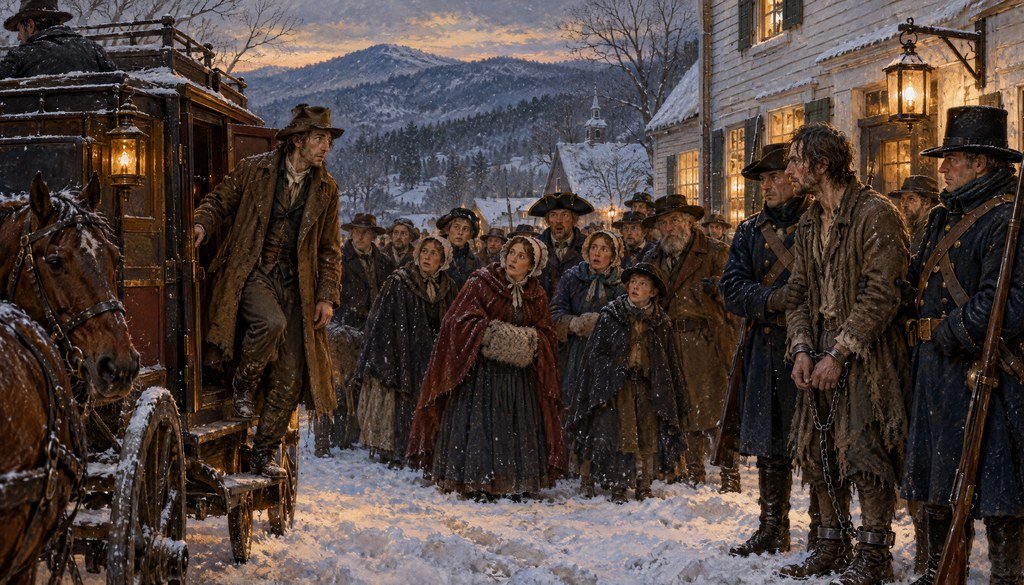
The passenger was Russell Colvin, the murder victim. He was in good health.
Historians usually call it the first known wrongful conviction in American history. It is also a case where nearly every piece of evidence pointed the wrong way, and where some people in Manchester never did agree that the man on the stagecoach was Colvin at all.
A household that didn't get along
The Boorns farmed in Manchester. Their sister Sally married Russell Colvin, and the families lived next door to each other, which by every account was a mistake.
Colvin drank, spent a lot of time in the local alehouses, and doesn't seem to have done much farm work. Some later accounts describe him as mentally unsteady, and he had a habit of wandering off for weeks at a time. Stephen and Jesse thought he was a lazy drunk and said so. Witnesses later remembered a violent quarrel between the brothers and Colvin shortly before he vanished.
In May 1812, Colvin disappeared. Because he had wandered off before, nobody panicked. A month later the United States declared war on Britain, and people speculated that he had joined the army or been pressed onto a British ship.
The Boorns didn't help themselves. Asked where Colvin had gone, Stephen is supposed to have said he hoped Colvin had gone to hell, and on another occasion that Colvin had gone "where potatoes won't freeze." Then Sally had a child that, as the whole town knew, could not have been her husband's. (Accounts differ on whether it was one child or two.) Stephen reportedly told people Colvin was dead while trying to help Sally get support for the baby. Gossip in a small farming town can run on a lot less than that.
Uncle Amos has a dream
For seven years, nothing happened. Then, in 1819, the brothers' elderly uncle, Amos Boorn, announced that Russell Colvin had visited him in a dream. In most versions it was a recurring dream, three nights running, and the ghost said he had been murdered and his body put in an old cellar hole in a potato field on the Boorn farm.
Sources disagree on how much the ghost said. The National Registry of Exonerations notes that the uncle didn't name any killers. Other accounts make the ghost more forthcoming. Either way, a dream isn't evidence, but it got the town digging.
The cellar hole held no body. It did hold a button, a penknife and a jackknife, plus some broken crockery, and Sally said the button and knife were her husband's. A few days later a sheep barn on the Boorn property burned down in a fire nobody could explain. Then a boy's dog dug up some bones from under an old tree stump nearby.
Three local doctors looked at the bones and declared them human. According to one account they compared them with a leg that had recently been amputated in town. After more study, the doctors changed their minds: the bones came from an animal. By then, though, the investigation was moving, and it didn't stop.
The cellmate who heard everything
Jesse Boorn was taken into custody. Stephen had moved about 200 miles away, to Denmark, New York, so he was out of reach for the moment.
The authorities put Jesse in a cell with a forger named Silas Merrill. Merrill soon reported that Jesse had confessed to him and described the killing. In exchange for his testimony, Merrill was let out of jail. If that arrangement sounds familiar, it's because jailhouse informants trading testimony for freedom still turn up in wrongful-conviction cases two centuries later.
Jesse then confessed for real, and put most of the blame on his brother. Stephen was brought back from New York. Sources disagree here too: some say a posse arrested him, others that he came back on his own. Once he was home, Jesse took back his confession, and Stephen produced one of his own. He admitted to killing Colvin but said it was self-defense, that Colvin had hit him first.
Why would two innocent men confess? Nobody can know for sure. They were under heavy pressure, they had a town convinced of their guilt, and Stephen may have figured a self-defense story was his best shot at avoiding the rope. Both brothers later retracted.
A trial in a church
The trial in 1819 drew such a crowd that it was held in the town's church. The prosecution had no body, bones that turned out to be animal, a button, a knife, a dream, a jailhouse informant and two confessions that both men had withdrawn. Witnesses remembered quarrels from seven years before.
The jury found both brothers guilty of murder, and both were sentenced to hang on January 28, 1820.
The Vermont Legislature then commuted Jesse's sentence to life in prison. It refused to do the same for Stephen, since his own confession had made him the one who struck the blow. He had a little over two months left.
The newspaper ad and the stranger in the hotel lobby
Not everyone in Manchester was sure. One of the few people who believed the brothers was Lemuel Haynes, a well-known minister who was preaching in Manchester at the time and counseled the Boorns in jail. Haynes, a Revolutionary War veteran, is often described as the first African American ordained by a mainstream Protestant church in the United States.
A notice went out asking for information about Colvin, saying that anyone who could find him "may save the life of an innocent man." Who paid for it depends on who's telling the story. The popular version says Stephen placed it himself. A biography of Haynes says Haynes paid for it. One writer who went back to the 1819 newspapers argues that the real break came from a letter to the editor, not an ad.
The sources do agree on what happened next. In late 1819, a traveler from New Jersey named Taber Chadwick was in a New York hotel when he overheard people discussing a New York Evening Post story about the Vermont murder case. The name caught him. Chadwick knew a Russell Colvin, a farmhand working near Dover, New Jersey, who was a bit addled and who talked about Manchester.
Chadwick wrote to Manchester's postmaster and to the Evening Post. The postmaster, who happened to be one of Stephen's own lawyers, apparently did nothing with it, which is strange. The Post printed Chadwick's letter in early December.
Getting a dead man onto a stagecoach
A Manchester native living in New York, James Whelpley, had been in that hotel lobby too, and he knew Colvin by sight. He went to the farm in New Jersey and found the man. The farmhand said he wasn't Colvin anymore, or at least he didn't want to be, but he knew a lot about Manchester for a stranger.
He also flatly refused to go back to Vermont. Given that Vermont contained Sally and her brothers, it's hard to blame him.
So Whelpley tricked him. He lured Colvin to New York City with the promise of meeting a young woman, who then left. Then he told Colvin that British warships made the usual route dangerous and they'd have to take a roundabout way home, and he put him on a stagecoach that went, by a roundabout route, to Manchester. The War of 1812 had been over for almost five years, but Colvin doesn't seem to have kept up with the news.
They arrived on December 22, about five weeks before the hanging. Crowds turned out. At the jail, Colvin saw Stephen in chains and asked why he was locked up. Told it was because people said Stephen had murdered him, Colvin's reply, as one contemporary pamphlet records it, was that Stephen had never hurt him.
The brothers were released and the charges dropped. Colvin went back to New Jersey and his farm work, presumably glad to be out of Vermont again.
Was it really him?
You'd think a walking, talking victim would settle a murder case. In Manchester, not quite.
Some villagers claimed afterward that the man on the stagecoach was an impostor. The theory, which still turns up among true-crime historians, goes like this: the Boorn family, with one son facing the gallows, found a confused drifter who resembled Colvin, coached him a little, and produced him in front of a town that hadn't seen the real man in seven years.
There are a few odd details that keep the idea alive. The farmhand told Whelpley he was no longer Colvin. He had to be tricked into making the trip. The postmaster who sat on Chadwick's letter was on the defense team. And the man left again as soon as he could.
Against that, plenty of people in Manchester had known Colvin for years, Sally among them, and the accounts say he was recognized. He knew details of the town. And mainstream legal histories, including the National Registry of Exonerations, treat the identification as settled. Nobody has ever produced hard evidence for the impostor theory. Then again, the murder case against the Boorns didn't have much hard evidence either.
The story that kept going
The case got a second life in print. In 1873 Leonard Sargeant published a 48-page pamphlet, Trial, Confessions and Conviction of Jesse and Stephen Boorn. Wilkie Collins, the English author of The Moonstone, used the Boorn case as the basis for his 1874 novella The Dead Alive (also published as John Jago's Ghost), moving the action and rewriting the cast. In 1932, Yale law professor Edwin Borchard included it in Convicting the Innocent, one of the first books to collect American wrongful convictions.
Read it today and the ingredients look very familiar: false confessions, a jailhouse informant paid in freedom, expert evidence walked back too late to matter, and a town that had made up its mind years before the trial. The ending is the unusual part. Most people wrongly convicted don't get to have their victim show up at the tavern.
The question left hanging
The Boorn brothers walked free because a dead man came back, and the case is still taught as the clearest proof that a conviction can be wrong. But it also left Manchester with a question it never fully answered: if Colvin was alive the whole time, what were those bones under the stump, who set the barn on fire, and why did two brothers confess to a murder that never happened?
And if you're with the doubters, then who was the man on the stagecoach?
Real Russell Colvin or a very lucky stand-in? Two hundred years on, you can make the call yourself.
Sources & further reading
- National Registry of Exonerations, Stephen Boorn
- VTDigger, Mark Bushnell, "Then Again: A case of who done ... what?"
- A&E, "The Boorn Brothers and the First Wrongful Conviction in America"
- Executed Today, "1820: Not Stephen Boorn, saved by newsprint"
- Wilkie Collins Society, review of The Dead Alive, ed. Rob Warden
- Wikipedia, Lemuel Haynes
- Borchard, Edwin M. (1932). Convicting the Innocent: Errors of Criminal Justice. Yale University Press.