Iceland Burned Witches for Nearly 60 Years. Almost Every One Was a Man.
Picture a European witch trial and you already have the image: a woman, probably old, probably poor, probably unpopular with her neighbors, standing in front of men who have already decided what she is. Take that picture to Iceland and it comes out wrong.
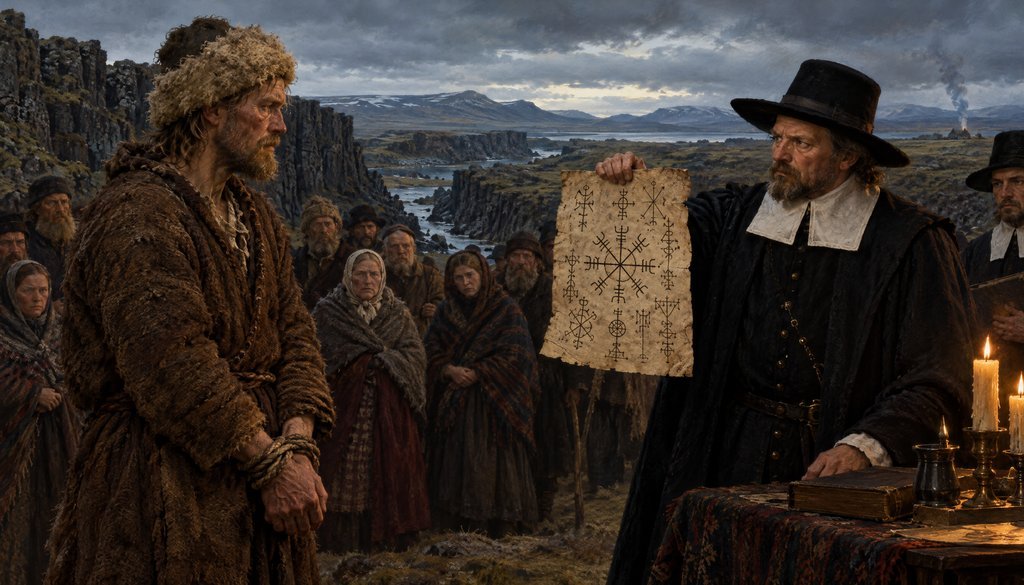
Between 1625 and 1683, Icelandic courts heard roughly 120 witchcraft cases. Only about nine or ten of them were against women. Twenty-one people were burned at the stake, and twenty of them were men. One woman died in Iceland's entire witch-hunting era, and she was convicted largely as an accessory to her son.
That ratio isn't a rounding error or one bad county skewing the count. It's the whole national record, running backwards from the rest of the continent.
(A note on the numbers, because you'll see them cited differently: the Museum of Icelandic Sorcery and Witchcraft keeps the authoritative list, and it names 21 confirmed executions plus six disputed cases that may or may not belong. Count some of the disputed ones and you get the "22 burned, 21 of them men" figure that circulates elsewhere. The ratio holds either way.)
The reason is in the courtroom evidence
Once you look at what Icelandic witches were accused of doing, the inversion starts to look almost obvious.
In Germany, in Scotland, and in the other places where witch panic ran hottest, the crime was a relationship with the devil: a pact made, a sabbath attended, a body given over. It was a crime of the flesh, and everyone assumed the flesh was female.
In Iceland, the crime lived on the page. Icelandic magic ran on galdrastafir, magical staves drawn or carved in a style descended from runic writing. You carved one to make fish come to your hook, to make sheep easier to herd, to find a thief, or to make a woman want you. These were technical drawings, copied by hand into galdrabækur, black books that circulated among farmers, students, and clergy.
So Icelandic magic required something that was very unevenly distributed in the 1600s: the ability to read and write.
Iceland was unusually literate for the period, but literate the way early modern societies usually were, which means skewed toward men, especially in the manuscript culture where magical texts actually lived. The line between scholarship and the occult was blurry. Men who'd studied abroad came home fluent in Latin, Greek, natural philosophy, and, not infrequently, the stuff in the black books. Historians reading the surviving grimoires have noticed that a lot of the spells are for seducing women, which tells you something about who was writing them.
When Iceland went looking for witches, it went looking for people with suspicious pieces of paper. It found men.
The confessions get strange fast
The museum's list of the executed reads like a catalogue of the specific, mundane, and occasionally ridiculous things that could get you killed.
Jón Rögnvaldsson was the first, burned in Eyjafjörður in 1625 for raising a ghost and owning papers with runic characters on them. He denied everything.
In 1654, three men were burned in a single episode at Trékyllisvík in the Strandir region. Þórður Guðbrandsson confessed, while imprisoned, to meeting the devil in the form of a fox. Egill Bjarnason confessed to killing a sheep by magic. Grímur Jónsson confessed to knowing magic runes and killing a sheep with a carved character.
Þórarinn Halldórsson, burned at Þingvellir in 1667, admitted carving Ægishjálmur into oak and practicing healing with magical signs. That's the Helm of Awe, the eight-spoked stave you've seen on every Icelandic tourist keychain ever manufactured. Þingvellir was the site of the national assembly.
Sigurður Jónsson, in 1671, admitted among other things to fighting off a ghost using herbs and his own semen. This was entered into the record, and he was burned.
Þorbjörn Sveinsson was a convicted thief found carrying magical signs in 1677. He said he'd used them to figure out who had stolen from him and to make sheep easier to handle. He was burned at Þingvellir.
Then there's Jón Jónsson the younger, burned in 1656, whose admitted offenses included using fretrúnir, or farting runes, against a girl. Fart runes were a documented magical technique, aimed at a specific person, entered as evidence in a capital trial, and part of the reason a man was burned alive. Icelandic sorcery contains multitudes.
The Kirkjuból affair, and the woman who won
Those fart runes come from Iceland's most famous witch case, and it's worth slowing down for, because of how it ends.
In 1654, a pastor named Jón Magnússon fell ill and became convinced he was under supernatural attack. He accused two of his parishioners, a father and son both named Jón Jónsson, of tormenting him with sorcery. Both were convicted and burned on April 10, 1656, and the pastor was awarded their property.
Emboldened, he went after the surviving family member: Þuríður Jónsdóttir, daughter and sister of the dead men. Her case went to Þingvellir and was dismissed. She walked free, then countersued the pastor for wrongful persecution, won, and was awarded his belongings as compensation.
Jón Magnússon spent his remaining years writing Píslarsaga, which translates as "Passion Saga" or "The Story of My Sufferings," a book-length account of how much he had suffered through all this. It survives. It's one of the more remarkable documents in Icelandic literature, written by a man who cast himself as the victim of a tragedy he started.
Behind these trials stands Þorleifur Kortsson, the local magistrate. He'd spent his early years abroad, apprenticed as a tailor in Hamburg at exactly the moment Hamburg was consumed by witch panic, and he came home knowing how a witch hunt was run. He presided over Trékyllisvík in 1654 and over the Kirkjuból trial in 1656. In a real sense, part of Iceland's witch hunt was imported from Germany.
One sick woman in one parsonage accounted for a third of the deaths
This is the detail that stopped me cold while researching, and the reason I think the Icelandic witch hunt deserves far more attention than it gets.
In Selárdalur, in the Westfjords, lived Páll Björnsson, a genuinely learned man. He'd studied abroad, knew Greek and Hebrew, and was considered among the foremost scholars of divinity in the country. An essay of his on Icelandic nature was published in the Philosophical Transactions of the Royal Society of London. By the standards of 17th-century Iceland, he was a scientist.
He also wrote Character Bestiæ (1674), a manifesto against magic, and he ran the deadliest witch hunt in Icelandic history.
It started around the turn of 1668 into 1669, when his wife Helga Halldórsdóttir fell ill with something that looked, to everyone involved, like possession. She recovered, then relapsed, then relapsed again. Each episode produced accusations, and the accusations produced burnings.
Count them from the museum's list. Jón Leifsson was burned in 1669 for causing Helga's illness, and Erlendur Eyjólfsson the same year for teaching Jón Leifsson magic. Magnús Bjarnason was burned in 1675 on the same charge. So was Lassi Diðriksson that year, who denied everything and was, the record notes, generally thought innocent; he was burned at Þingvellir anyway. In 1678 came Jón Helgason and his mother, Þuríður Ólafsdóttir, the only woman confirmed executed in Icelandic history, condemned on Páll Björnsson's word. Finally, in 1683, Sveinn Árnason was burned for an illness suffered by Páll and Helga's daughter.
That's seven people from one household's sickbed, roughly a third of every confirmed witch burning in Iceland. They trace back to one woman's recurring illness and to a scholar husband whose theology told him what illness meant. Sveinn Árnason, in 1683, was the last.
And then there are the pants
The Museum of Icelandic Sorcery and Witchcraft is in Hólmavík, in Strandir, the same region that produced the Trékyllisvík burnings. Its most-discussed exhibit, and the thing you'll end up telling people about at dinner, is a reconstruction of nábrók: necropants.
The recipe, as preserved in Icelandic folk-magic tradition, goes like this. You get written permission from a living man to use his skin after he dies. When he dies, you dig him up and flay him from the waist down in a single unbroken piece. You step into it, and the skin grafts to your own. Then you steal a coin from a poor widow and place it in the scrotum along with a particular magical stave. From then on the scrotum draws money and never empties, as long as the original coin stays put.
Nobody has ever found a real pair. There's no archaeological nábrók and no contemporary court case about a man wearing another man's legs. Necropants are documented folk magic, a recipe people passed along and believed in, and the museum's exhibit is an honest reconstruction rather than a relic. Anyone selling you "the preserved necropants of Iceland" is selling you a very good prop.
As a window into what Icelanders in the 1600s thought magic was, though, it's perfect. Look at the ingredients: a written contract, a specific drawn symbol, and a procedure that has to be followed exactly. Even at its most grotesque, Icelandic sorcery is bureaucratic. It's paperwork, and paperwork is what got twenty men burned.
Sources & further reading
- The Museum of Icelandic Sorcery and Witchcraft keeps the definitive list of the executed, case by case. It's the primary source for most of the names above, and it's free to read.
- Wikipedia's Witch trials in Iceland and Kirkjuból witch trial entries are solid on the legal framework.
- History Hit, "The unique horror of Iceland's witch hunts", covers the gender inversion.
- Atlas Obscura, "Objects of Intrigue: Necropants", has the pants.
- For the academically inclined, "A Story of Sufferings? A Re-Examination of Male Witchcraft in Iceland" digs into the Kirkjuból case properly.