The Mad Gasser of Mattoon: The Phantom Who May Never Have Existed
Around 11 o'clock on the night of September 1, 1944, Aline Kearney was in bed in her house on Marshall Avenue in Mattoon, Illinois, when she noticed a smell. It was strong and oddly sweet. Then her legs started going numb, and her lips and throat began to burn.
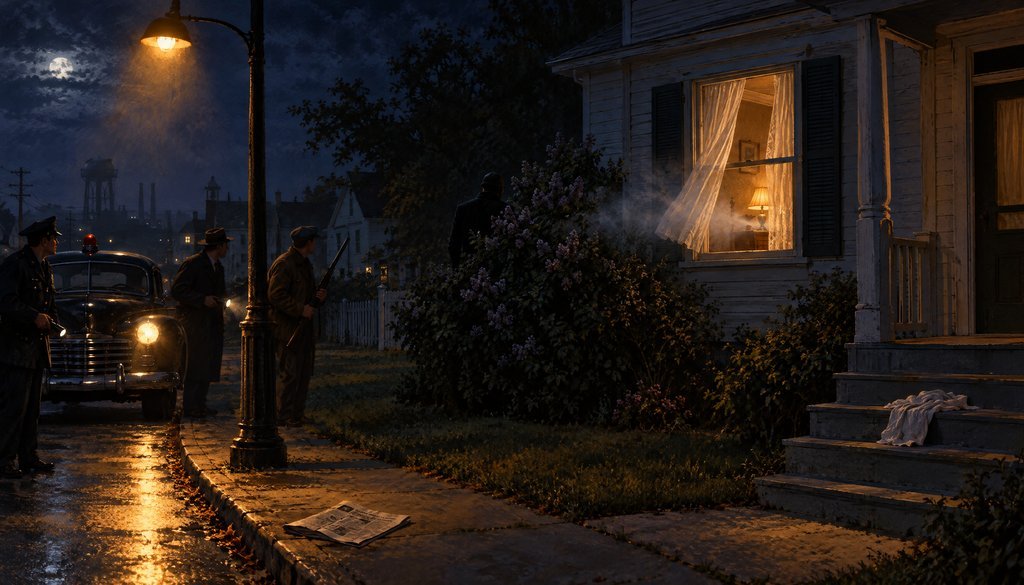
Police came and found nothing. About an hour and a half later, her husband Bert, a local taxi driver, came home and spotted a man standing near the window. The man ran. Bert described him as tall, in dark clothing, wearing a tight-fitting cap, and that one sketch became the face of a two-week panic. Over those two weeks, Mattoon's police heard more than two dozen reports of gas attacks, state investigators and the FBI came to town, and residents went out at night with guns. The prowler got a nickname and, eventually, his own article in an academic psychology journal.
He was never caught. There's a decent chance he never existed.
A small town with a lot on its mind
Mattoon sits about 49 miles south of Champaign, and in 1944 it had roughly 18,000 people. It was late summer during the Second World War, so plenty of local men were overseas, the newspapers were full of the war, and the town had a war plant of its own. It was hot, so people slept with their windows open, which matters later.
The Kearney case is the one everybody remembers, but it probably wasn't the first. The night before, August 31, a man named Urban Raef on Grant Avenue woke up to a strange odor, felt sick and weak, and vomited. His wife tried to get up and check the pilot light on the kitchen stove, and found she was partly paralyzed and couldn't get out of bed. (Sources disagree on which case came first, so "late August or early September 1944" is the safe version.)
The symptoms in both houses became the pattern for every report after them: a sweet or strong smell, then nausea, vomiting, weakness and, for some people, partial paralysis of the legs that wore off after about an hour. Nobody died, and nobody suffered lasting harm.
The newspaper gets involved
On September 2, the Daily Journal-Gazette ran the Kearney story under the headline "Anesthetic Prowler on Loose." It framed the Kearneys as the first victims, which, besides being probably wrong, carried an implied promise that there would be more. Some researchers think that framing did a lot of the work for what came next.
And more did come. About half a dozen similar reports came in over the next few days. Victims couldn't describe anyone clearly, and police found no clues.
The cloth on the porch
On September 5, Carl and Beulah Cordes of North 21st Street found a white cloth lying on their porch. Beulah picked it up and sniffed it, which is either brave or the most 1944 thing anyone could do, and became violently ill. Her face swelled, her mouth and throat burned, she vomited, and her legs went partly numb.
Police found two more items nearby: a well-used skeleton key and a nearly empty tube of lipstick. That combination doesn't add up to anything in particular, but it sounds like something, and in a town on edge that was enough.
The lab analysis of the cloth found no chemical that could explain what happened to Beulah.
The same night, Mrs. Leonard Burrell reported that a stranger had come in through her bedroom window to gas her.
Peak panic
From roughly September 6 to 10, Mattoon lost its nerve. Reports piled up. People found footprints under windows and torn window screens. On September 7, sisters Frances and Maxine Smith reported a blue vapor and a motorized buzzing sound.
Locals armed themselves and started following police cars around town to be there when the gasser was caught. Police ended up arresting some of these volunteer chasers just to keep somebody from getting shot. One woman, arming herself against the gasser, accidentally shot a hole in the wall of her own house. The gasser, whoever he was, never laid a finger on that wall.
Police asked people to stop lingering outdoors, break up the patrols, and go easy with the firearms. The Illinois Bureau of Criminal Identification sent investigators, and the FBI got involved. The suspect list grew to include a disgruntled chemistry teacher, a prankster, an escaped prisoner of war, and a wealthy man with a laboratory in his basement. Army chemical-warfare experts considered chloropicrin, a sweet-smelling poison used on rodents, and even mustard gas, but neither matched the symptoms.
My favorite report from this stretch came from a local fortune teller named Edna James, who reportedly said she was gassed by an "ape-like" man with a spray gun. A fortune teller, you'd think, might have seen that one coming.
On September 11, the Chicago Herald-American ran the headline "STATE HUNTS GAS MADMAN." Richard Piper, superintendent of the state Bureau of Criminal Identification and Investigation, went on record: "The existence of the anesthetic, or whatever it is, is genuine." The "or whatever it is" is doing a lot of work there.
Then the police chief changed his mind
On September 12, the Daily Illini reported that 33 people had smelled the gas in 12 days. The same day, Police Chief C. E. Cole announced that there was no prowler.
Cole said many of the reports likely had ordinary causes, magnified by fear and anxiety, especially among women whose husbands and sons were away at war. He suggested fumes from a local industrial plant, carbon tetrachloride or trichloroethylene, carried on shifting night winds through all those open windows. The man Bert Kearney saw, Cole said, was most likely a bystander who'd come over to see what the commotion was about.
The Atlas-Imperial plant pushed back. It said it had only five gallons of carbon tetrachloride on hand, inside its firefighting equipment, and denied that its other chemicals could be responsible.
The next day's Daily Illini headline was "Mattoon Prowler Claimed Fake: Plant Fumes Cause Rumors, Says Chief." Some of the "attacks" ended up with very mundane explanations, including, according to later accounts, spilled nail polish.
Not every official was on the same page, though. Thomas V. Wright, the state public health commissioner, managed to say both "There is no doubt that a gas maniac exists and has made a number of attacks" and "The whole town is sick with hysteria."
The last notable report came on September 13. Bertha Burch said her gasser was a woman dressed as a man, and a woman's footprints were reportedly found. After that, the reports dropped off sharply, almost as quickly as they had started.
So what actually happened?
There are three main theories, and each one has a weak spot.
A real prowler
Piper called the anesthetic genuine, Wright said a gas maniac existed, Bert Kearney saw an actual man at his window, and people found footprints and torn screens. Against that: nobody ever recovered a chemical, the cloth tested clean, nobody was ever charged, and the gasser's description kept changing, all the way to a woman in men's clothes.
Industrial fumes or household causes
This was Chief Cole's theory, and there was a plant nearby using solvents. But the plant denied it, its workers reportedly had no symptoms, and the attacks were scattered all over town, which is hard to square with one source of fumes riding the wind.
Mass hysteria
Today researchers would call it mass psychogenic illness, meaning real symptoms (people genuinely did vomit and feel weak) set off by fear and suggestion rather than a toxin. The timing fits: reports climbed after the newspaper coverage and fell off right after the police announcement. Wartime anxiety was everywhere, and the descriptions were vague and kept shifting. The catch is that this theory doesn't prove every report was imagined. Some researchers think a real attacker is plausible for at least a few of the incidents.
The hysteria explanation got its academic stamp quickly. In 1945, psychologist Donald M. Johnson published "The 'Phantom Anesthetist' of Mattoon: A Field Study of Mass Hysteria" in the Journal of Abnormal and Social Psychology. Psychologist James P. Chaplin backed the hysteria view in 1959, and the case became a standard example in the field. If you want to go deeper, Scott Maruna's 2003 book The Mad Gasser of Mattoon: Dispelling the Hysteria argues the other side.
Wait, this happened before?
Ten years earlier, Botetourt County, Virginia, went through almost exactly the same thing.
On December 22, 1933, the Cal Huffman family near Haymakertown became sick in the night. All eight family members had nausea, headaches and trouble breathing, and 20-year-old Alice Huffman was hit hardest. A doctor had to revive her with artificial respiration. Police ruled out ether, chloroform and tear gas, but couldn't identify what the gas was. Under a window, they found a woman's shoe print.
More gassings were reported across the county through January 1934, and woman's shoe prints showed up again. The county offered a $500 reward, and the state legislature passed a law with prison terms of up to 10 years for releasing noxious gases. At least one incident was traced to a coal stove. The last reported attack was on February 3, 1934, at the A. P. Scaggs home in Nace. Authorities eventually concluded there was no gasser, and nobody was ever caught.
The parallels are hard to ignore: attacks through windows, a smell followed by nausea, full recoveries, and a woman's footprints. Nothing links the two cases, but Mattoon wasn't the first town to lose sleep over a phantom with a gas can.
The question left hanging
Panics like this have a long history. In 1518, people in Strasbourg reportedly danced for days without being able to stop, and Mattoon is the 20th-century American version of that kind of story, with headlines and an FBI file instead of a cathedral square.
Still, the line that sticks with me is Piper's: "The existence of the anesthetic, or whatever it is, is genuine." He was half right. Something real made those people sick. Whether it came out of a spray gun, a factory smokestack or the town's own nerves, nobody has ever settled.
What's your verdict: a real prowler, bad air, or a town that scared itself sick? Tell us in the comments.
Sources & further reading
- Wikipedia, Mad Gasser of Mattoon
- University of Illinois Library, History, Philosophy & Newspaper Library, "The Mad Gasser of Mattoon"
- Atlas Obscura, "The Mad Gasser of Mattoon"
- Legends of America, "Mad Gassers of Virginia & Illinois"
- Johnson, D. M. (1945). "The 'Phantom Anesthetist' of Mattoon: A Field Study of Mass Hysteria." Journal of Abnormal and Social Psychology, 40(2), 175-186.
- Maruna, Scott (2003). The Mad Gasser of Mattoon: Dispelling the Hysteria.