One Snowy Night in 1855, Something Left Hoofprints Across Devon. Some of Them Were on the Rooftops.
On the morning of Friday, February 9, 1855, people along the Exe estuary in south Devon opened their doors onto fresh snow and found that something had been walking around in the night. The tracks were small and shaped like a hoof. They ran through gardens and churchyards and along the tops of walls, and in some places, people said, they went straight up onto the roofs of houses and down the other side.
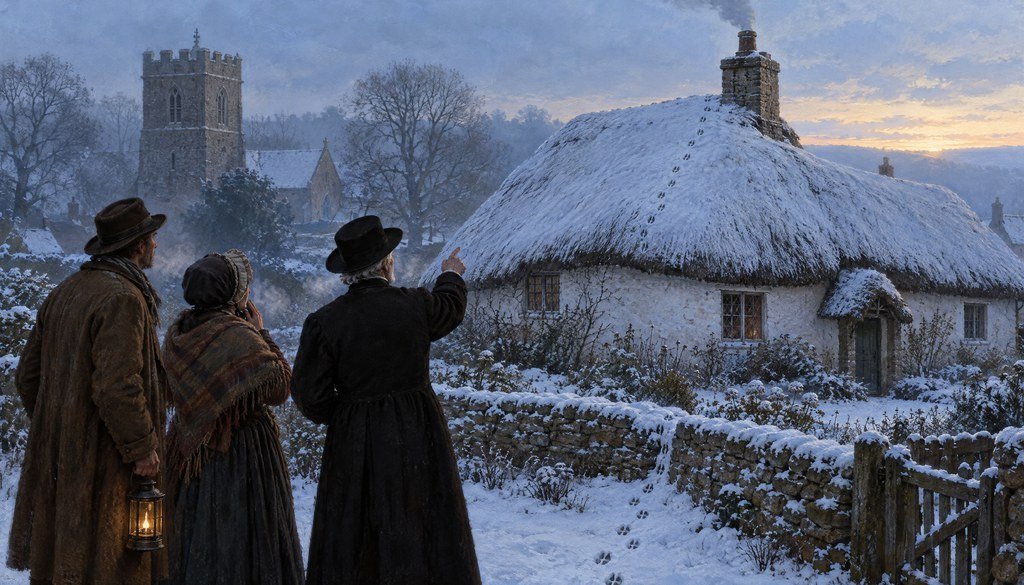
By the end of the following week The Times of London was reporting "considerable sensation" in Topsham, Lympstone, Exmouth, Teignmouth and Dawlish. Parties of men had followed the prints for miles without finding what made them. The paper noted that the more superstitious residents had settled on an answer: the marks were Satan's. Its own verdict was shorter. "At present it remains a mystery."
It still does, more or less, although the list of suspects has grown to include a badger, an otter, a toad, a swan, a pair of kangaroos, a runaway balloon and a mouse.
A hard winter and a strange morning
The winter of 1854 to 1855 was a bad one. The Exe and the Teign both froze in places, hard enough that people held games and a feast on the ice. On the night of Thursday, February 8, heavy snow fell across south Devon. A correspondent to the Exeter and Plymouth Gazette described what came next: rain, an easterly wind, and then a frost before dawn. So the snow fell, partly thawed and froze again, all before anyone was up to look at it.
The earliest known report appeared in a local paper, the Western Luminary, on February 13. It described prints at Dawlish that were "exactly, in shape, like a donkey's hoof" and seemed to have been made by "some two-footed animal," since they ran in a single line, one in front of the other, instead of in pairs. The paper passed along a rumor that a monkey had escaped from a traveling menagerie. "Many parties have traced the prints for miles," it said, and none of them had solved it.
What the tracks looked like
The measurements vary depending on who held the ruler. The Times gave the prints as 1.5 to 2.5 inches across and about 8 inches apart. Other witnesses reported marks up to 4 inches long and 3 inches wide, with a stride anywhere from 8 to 16 inches. Most accounts agree on the single file. Some prints looked cloven, some looked like a tiny horseshoe, and a few reportedly showed claws.
Stranger than the shape was where the tracks went. They were reported on rooftops and on top of high walls. A trail was said to stop on one side of a haystack and carry on from the other side, with the hay untouched. Two witnesses said a line of prints led up to a drainpipe a few inches wide and came out the far end. Prints turned up on both banks of the Exe estuary, which is about two miles across at that point, and people concluded that the walker had simply crossed it.
Reports eventually came in from more than 30 places, nearly all of them in south Devon, with one or two across the county line in Dorset. Estimates of the total distance run from 40 miles to more than 100.
Guns, hounds and a kangaroo
Devon did not take this calmly. At Dawlish a group of tradesmen armed themselves and followed one set of tracks for about five miles, and found nothing at the end of it. A much-repeated story has a hunt tracing the prints to a wood near Dawlish, where the hounds went in and came back out baying and terrified. That one is hard to pin down and may have improved with retelling.
The Western Times reported that Exmouth had been "thrown into a state of alarm." On February 13, fresh tracks appeared in Topsham, crossing the churchyard right up to the church door. A letter in the Exeter paper observed that "the poor are full of superstition and consider it little short of a visit from old Satan." The Times said the subject had been taken up from the pulpit.
One clergyman came up with a creative response. The Reverend G. M. Musgrave (some sources spell it Musgrove, and they also disagree on whether his church was at Withycombe Raleigh or Lympstone) told his congregation that a couple of kangaroos had reportedly escaped from a private menagerie at Sidmouth, and that the prints might be theirs. Nobody has ever found evidence that any kangaroos got loose. Musgrave didn't seem to mind. In a letter printed in the Illustrated London News on March 3, he explained that his parishioners had been "dreading to stir out after sunset" for fear of the Devil, and that he was grateful a kangaroo had served to chase the idea away.
The experts weigh in
The Illustrated London News became the national clearing house for theories. On February 24 it printed a long letter signed "South Devon," along with a sketch of the prints. The writer said the marks were the same size in every parish, that the trail had cleared a wall 14 feet high, and that "no known animal could have traversed this extent of country in one night." He put the total at more than a hundred miles.
"South Devon" presented himself as an experienced countryman. Papers that surfaced almost a century later showed he was William D'Urban, who was 19 at the time. (He did go on to become the first curator of the Royal Albert Memorial Museum in Exeter, so the interest in natural history was real.)
The March 3 issue brought the replies. The biggest name was Richard Owen, the anatomist who had coined the word "dinosaur" in 1842. Owen said the tracks belonged to a badger, "almost the only plantigrade quadruped we have in this island," and suggested several hungry badgers had been out that night. He added a line that still gets quoted: "The onus of the proof that one creature made them in one night rests with the assertor."
A doctor from Topsham wrote in to propose an otter, while admitting, "I am not acquainted with the otter myself." Another reader favored the great bustard. A week later Thomas Fox sent in drawings of what he called rat prints from a garden, showing how a hopping rodent's four feet can land together and leave one mark that looks split down the middle. The Exeter Flying Post nominated toads, after a man in Torquay followed a trail across his garden and found a toad at the end of it.
The balloon, the swan and the stilts
Later generations added their own ideas, and some of them are wonderful.
In 1985 the novelist Geoffrey Household published a theory he had from a Major Carter, whose grandfather had worked at Devonport Dockyard. According to this family story, an experimental balloon broke loose from the dockyard that night and drifted across the county trailing two shackles on its mooring ropes, which bounced along and stamped out the prints before the balloon came down at Honiton. It would explain the roofs. It doesn't explain how a rope could drag across half a county of trees and chimneys without snagging, or why nobody in 1855 mentioned a balloon.
Other proposals include a swan wearing padded shoes, an unknown sea creature (from the former naval officer Rupert Gould, who pointed out that a badger leaves a staggered double line and does not walk across roofs) and a 1973 memoir claiming that Romani families made the tracks on stilts to frighten off rivals. In 1972 a writer in Flying Saucer Review blamed a UFO.
The man who read everything
The most thorough work on the case was done by the historian Mike Dash, who tracked down the surviving newspaper reports, letters and sketches and published them in 1994 in an 80-page paper called "The Devil's Hoofmarks."
His reading of the evidence takes a lot of the air out of the legend. The eyewitness testimony, he pointed out, comes mainly from "two clergymen, a doctor and a young gentleman." No one followed a single unbroken trail for anything like 100 miles; the longest pursuit on record is the five miles at Dawlish. Nobody saw anything cross the estuary, either. "All we can say with certainty," Dash wrote, "is that hoofmarks were found on both sides of the Exe estuary."
There is also the one man known to have been outdoors that night. The tenant of Aller Farm, near Dawlish, told his vicar that he had watched his own cat's pawprints change as the snow thawed in the rain and then froze again. By morning they looked like small hoofs.
Dash's conclusion was that the cause was "almost certainly multiple." Donkeys and ponies probably made some marks, cats and other animals made others, and the weather reshaped a lot of them. A few, like the tidy trail to the church door at Topsham, may have been hoaxes. (The folklorist Theo Brown suspected locals who were feuding with their vicar.) For the classic single-file prints, his best candidate was the wood mouse. In the 1950s the zoologist Alfred Leutscher found trails in Epping Forest that closely matched the Devon sketches, made by wood mice bounding through snow. Mice also climb walls, cross roofs and fit through drainpipes.
The skeptic Joe Nickell added a human explanation for the rest. Once everyone was talking about hoofprints, people went outside looking for hoofprints, and found them.
The question left hanging
Even Dash, after all that, ended his survey with three words: "The mystery remains." The explanations cover most of the reports. They need several different animals, a freak of the weather, a few pranksters and a county-wide case of nerves to all show up on the same night. Each of those is ordinary enough, and it is still a lot to ask of one Thursday.
Nobody took a photograph. All that survives is a handful of sketches and letters, and the prints themselves melted within days. Similar tracks have been reported since, in Scotland, Belgium and Hull, and no one has caught the walker in the act.
So what would you have decided, standing in a Devon garden that morning with a neat line of hoofprints running up to your wall and continuing on the other side: mice, a neighbor with a sense of humor, or something you would rather not meet after dark?
Sources & further reading
- Dash, Mike (1994). "The Devil's Hoofmarks: Source Material on the Great Devon Mystery of 1855." Fortean Studies 1, pp. 71-150.
- Wikipedia, Devil's Footprints
- Historic Mysteries, 1855 Sketches and Letters Show the Devil's Footprints Were Never All Alike
- David Castleton, The Serpent's Pen, The Devil's Footprints: Devon's Diabolical Hoofmarks in the Snow
- Discovery UK, The Mystery of the Devil's Footprints
- Brian Dunning, Skeptoid #31, The Devil Walked in Devon
- Brown, Theo (1950, 1952). "The Great Devon Mystery of 1855." Report and Transactions of the Devonshire Association 82 and 84.
- Household, Geoffrey, ed. (1985). The Devil's Footprints: The Great Devon Mystery of 1855. Devon Books.