The Mystery of Pegasus: Real but Extinct Winged Horse
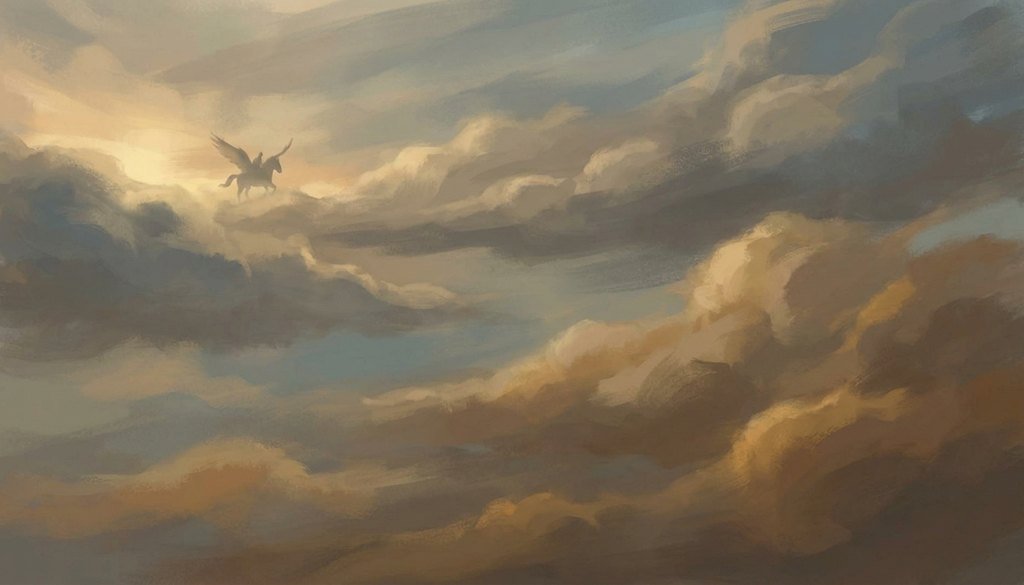
Imagine looking up and seeing a horse against the sky. Not falling, but climbing. Wings the width of a barn door, hooves striking at nothing. The whole impossible shape of it moving with purpose. Pegasus has been part of human storytelling for nearly three thousand years, stamped onto coins, mounted on temple roofs, and hung in the night sky as a constellation. That is a long time for a story to survive without something behind it. The name may come from the Greek pēgē, meaning "spring" or "well" or, some scholars argue, from a Luwian word for lightning. But were winged horses only ever a story? Or were they an animal that people saw, described, and then outlived? When you follow the trail back, it goes further and stranger than you would expect.
Key Takeaways
- Pegasus appears in Greek writing as early as Hesiod, roughly 700 BC, and in art even earlier.
- The city of Corinth minted Pegasus on its silver staters for centuries; the coins were nicknamed poloi, "colts."
- Winged horses appear independently in Etruscan, Assyrian, Persian, and Central Asian art, not just Greek.
- One proposed etymology links the name to the Luwian pihassas, "lightning," matching Pegasus's job carrying Zeus's thunderbolts.
- A real horse species was declared extinct in the wild within living memory and then came back.
Introduction: Exploring the Enigma of Pegasus
Ancient people did not treat Pegasus as a throwaway character. He was put on money, on temples, and on the shields of soldiers. Cultures that never traded a word with each other arrived at the same picture: a horse that flies. That kind of independent agreement is exactly the sort of thing that makes a person wonder.
Unveiling the Ancient Legends and Myths
The oldest surviving account comes from Hesiod's Theogony. When Perseus beheaded Medusa, two beings sprang from her blood: Pegasus and his brother Chrysaor. Their father was Poseidon, god of the sea and, less famously, of horses. Pegasus flew to Olympus and took a job carrying thunderbolts for Zeus.
The other half of the story belongs to Bellerophon, the hero of Corinth. Athena gave him a golden bridle, he caught Pegasus drinking at a spring, and together they killed the Chimera. Then Bellerophon decided he had earned a seat among the gods and flew for Olympus. Zeus sent a gadfly. The horse bucked. Bellerophon fell.
Cultural Depictions Across Civilizations
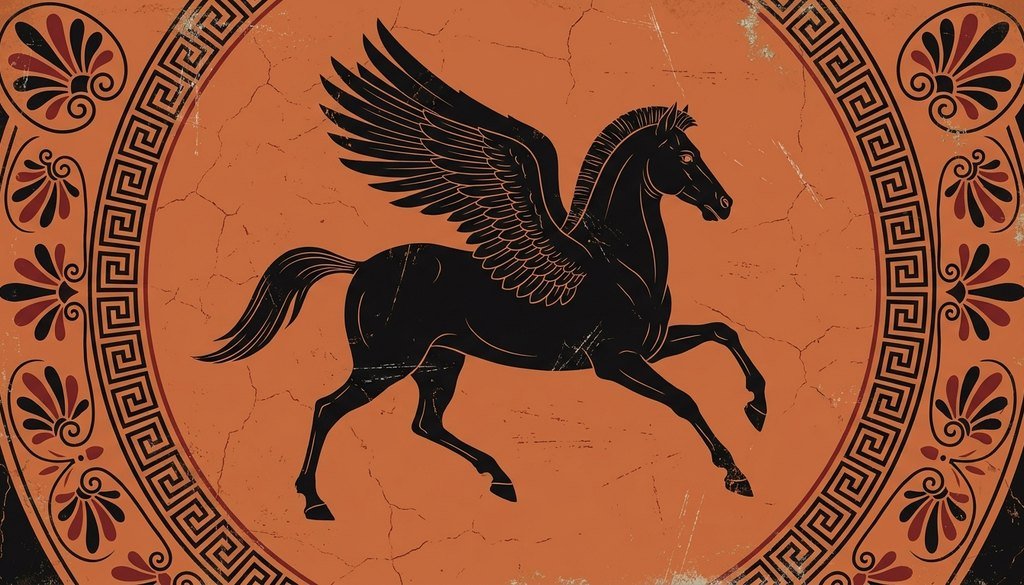
Corinth put Pegasus on its silver coinage from the late 6th century BC onward, usually beside the archaic letter qoppa for the city's name. Corinthian colonies across the Mediterranean copied the design as a mark of kinship. In Etruria, a pair of terracotta winged horses reared across the pediment of the great temple at Tarquinia around 400–390 BC. Recovered in 1938 in more than a hundred pieces, they are now the symbol of the town. Winged hybrid animals guard Assyrian doorways. Turkic tradition has the tulpar. Han-dynasty China prized the "heavenly horses" of Ferghana, animals so fast that poets gave them wings.
Textual Accounts: Evidence in Writing
Hesiod, Hippocrene, and the Spring of the Muses
Hesiod says Pegasus got his name from the pēgai, the springs of Ocean where he was born. That etymology is probably a poet's wordplay rather than real linguistics, but it stuck, and it anchored Pegasus to water for the rest of antiquity. On Mount Helicon, the spring called Hippocrene ("horse's fountain") was said to have opened where his hoof struck the rock. It became sacred to the Muses, which is why "drinking from the Hippocrene" survives as a phrase for poetic inspiration.
Lightning, Not Water: The Luwian Theory
A rival etymology, first proposed in 1952, traces the name to the Luwian pihassas, meaning lightning. There was a Luwian-Hittite weather god of southern Cilicia called Pihassassi, depicted with thunder and lightning. Supporters point out that Hesiod already has Pegasus hauling thunderbolts for Zeus, a strange job for a horse named after a puddle. The theory remains widely cited, though the historian Robin Lane Fox has argued the borrowing likely ran the other way: Greek visitors to Cilicia heard about Pihassassi and assumed they had found their own Pegasus under a foreign name.
The Curious Case of Przewalski's Horse: A Historical Parallel
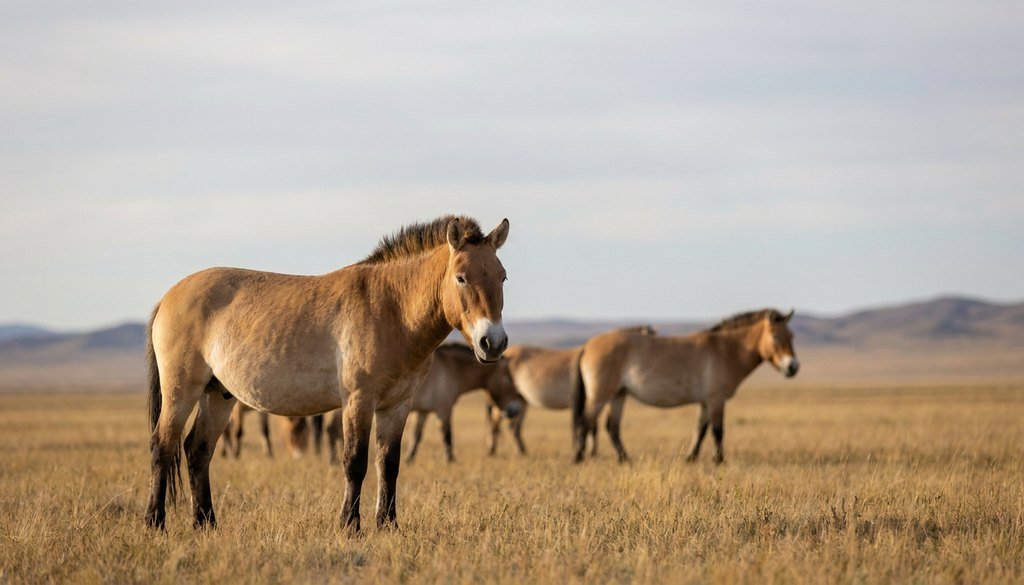
Here is a horse story that sounds invented and is not. Przewalski's horse (stocky, dun-colored, upright-maned, never domesticated) was declared extinct in the wild by the end of 1969. Gone. The entire species survived as roughly a dozen animals in captivity, with the modern population descending from about fourteen founders.
From Extinction to Resurrection
Careful international breeding brought the count to nearly a thousand by 1990. Reintroductions to Mongolia began that decade, and today the horses run again at Hustai National Park and Takhin Tal. A wild horse walked out of extinction inside a single human lifetime.
Lessons Learned: Embracing the Unexplained
The lesson is not "therefore Pegasus." The lesson is smaller and more useful: our confidence about what has and hasn't existed is younger and shakier than it feels. A species can vanish so completely that the wild forgets it, and still be standing in a paddock in Prague. That should make us slower to sneer at old descriptions of animals we can't presently locate, and equally slow to accept them.
An essay on how Pegasus was actually real but is now extinct
Set the objections aside for a moment and look at what a believer would have to work with. It is a better hand than you'd think.
Pegasus is not one culture's daydream. Greeks, Etruscans, Assyrians, Persians, Turkic steppe peoples, and Han Chinese poets all reached for the same image, often without contact. The Greeks treated him as specific rather than generic: he had a birth, a father, a brother, a named spring, a named rider, and a documented death of that rider. Corinth staked its civic identity on him for three hundred years, which is a strange thing to do about an animal everyone knows is imaginary.
And there is a real mechanism by which an ordinary animal becomes a winged one. To a people who had never seen a horse under saddle, a mounted rider arriving at a gallop is a creature that moves faster than anything in the world should move. Speed reads as flight. The Ferghana horses got wings in Chinese poetry for exactly that reason, and nobody in Chang'an believed they were literally airborne. Wings, in the ancient visual vocabulary, were less a description than an adjective: they meant divine, fast, belonging to the sky.
So: a real, astonishing animal, arriving in cultures unprepared for it, described in the only language available. That is a story where Pegasus is both real and never existed, which is the most satisfying version and, unfortunately, not the one the anatomy will let us have.
Fossils and Misread Bones: The Missing Link?
The dinosaur-fossil explanation that works so well for dragons and griffins works poorly here, and it is worth being straight about why.
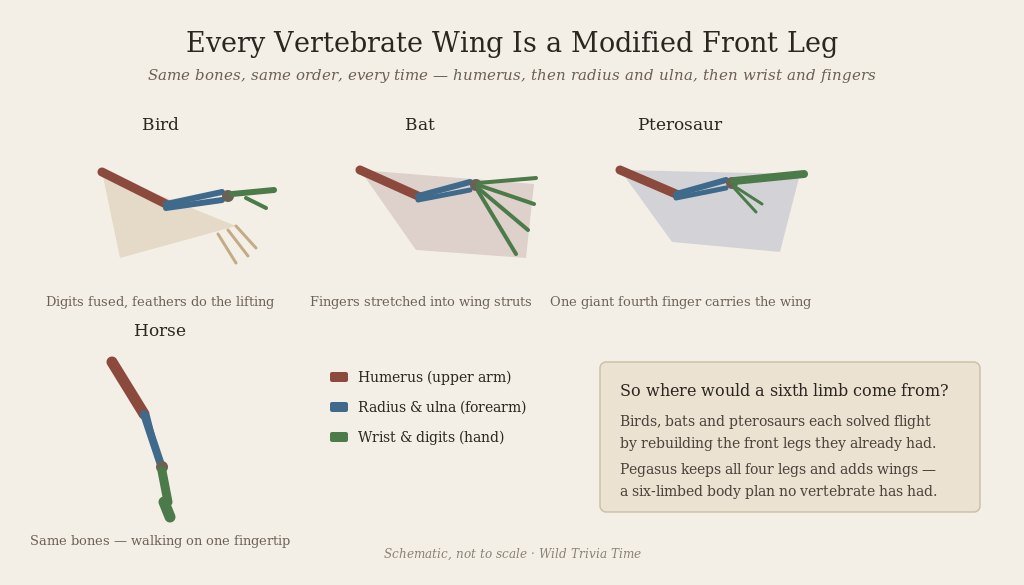
Herodotus's griffins may well have come from Protoceratops skeletons weathering out of the Gobi. But nothing in the fossil record resembles a winged horse, because nothing in the fossil record could. Every land vertebrate that has ever lived (every mammal, bird, reptile, amphibian) descends from a four-limbed ancestor. Birds, bats, and pterosaurs all fly on modified front legs. None of them grew a fifth and sixth limb; they repurposed what they had.
A winged horse needs six limbs: four for standing, two for flying. No vertebrate lineage has ever produced that body plan. Not once, in about 370 million years. Pegasus is not an animal we haven't found yet. He is an animal on a branch of the family tree that does not exist.
Winged Horses Beyond Greece: A Wider Perspective
The Greek Pegasus is one entry in a large catalogue. Assyrian palaces were guarded by winged bulls and lions. Etruscan artists gave winged horses to temple pediments and tomb walls. Norse myth answered the "impossible horse" question differently, giving Sleipnir eight legs instead of wings. Islamic tradition describes the Buraq, the swift steed of the Prophet's Night Journey, often depicted with wings in later Persian and Mughal painting.
Wings, Speed, and Cultural Symbolism
What unites them is not a shared sighting. It is a shared problem. Every culture that had horses needed a way to say this animal is more than an animal, and wings were the available shorthand. Where the Greeks reached for feathers, the Norse reached for extra legs, and Chinese poets reached for metaphor: three solutions to one expressive need. The pattern looks like convergent storytelling, not convergent zoology.
The Biological Implausibility of Pegasus
Even granting six limbs, the physics closes the door.
Flight has a weight ceiling. The heaviest flying bird alive is the kori bustard at up to about 18 kg, and it is already straining the theoretical envelope of roughly 10–15 kg for sustained horizontal flight. The largest flying animal ever known, the pterosaur Quetzalcoatlus northropi, stood as tall as a giraffe with a wingspan over 10 metres and is estimated at up to 250 kg. Current modelling suggests that is close to the hard limit, with the real bottleneck being takeoff rather than cruising.
A riding horse weighs 400 to 500 kg. That is roughly double the largest creature ever to leave the ground under its own power, and the horse brings none of the equipment. Birds have hollow, air-filled bones and a deep keeled sternum anchoring flight muscles that run 15–20% of body mass. A horse has dense marrow-filled bones, a flat breastbone with nothing to anchor to, and a digestive system built for processing enormous volumes of low-energy grass, the opposite of the weight discipline flight demands.
You could not fix this by making the wings bigger. Past a certain span the animal cannot generate enough force to get airborne before gravity wins, which is precisely where Quetzalcoatlus was already sitting.
From Temple Roof to Corporate Logo
Pegasus never lost his job as a symbol; he only changed employers. Renaissance humanists made him the emblem of poetic inspiration, on the strength of that hoofprint at Hippocrene. He has since served as the mark of an oil company, a film studio, an Italian marble quarry, and roughly every third fantasy publisher.
Pegasus in Fantasy and Pop Culture
Modern fantasy inherited him wholesale: Disney, Tolkien's imitators, tabletop bestiaries, an entire tier of My Little Pony. What is notable is how little the design has changed in 2,700 years. The Corinthian coin engraver and the modern illustrator draw the same silhouette. Very few images have that kind of shelf life.
The Real Pegasus
Here is the part that is not speculation at all.
There is a living genus called Pegasus: the seamoths, small armored fish of the Indo-Pacific with broad wing-like pectoral fins, family Pegasidae. They cannot fly, but they are the only organisms on Earth entitled to the name.
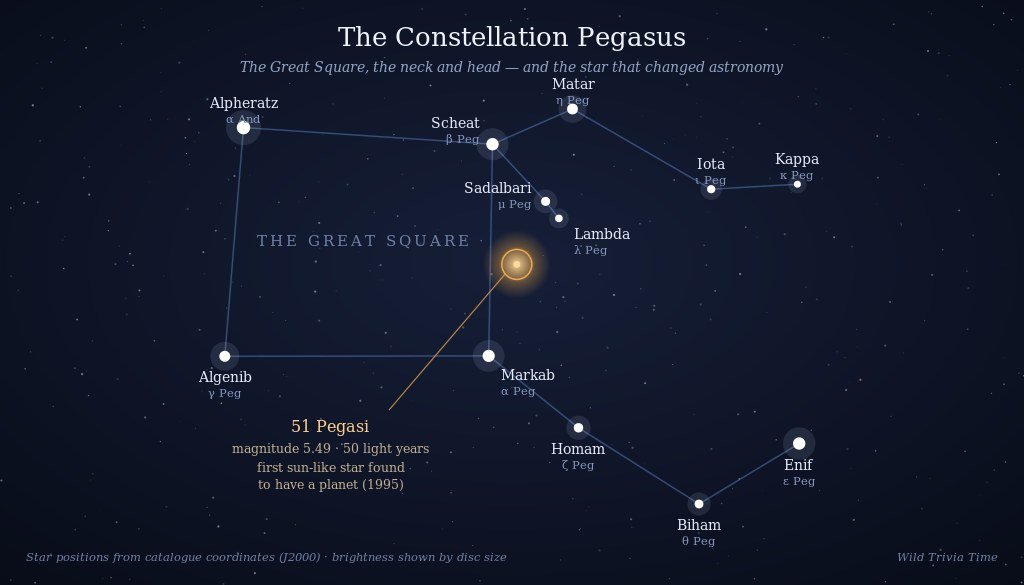
There is the constellation Pegasus, one of the 48 catalogued by Ptolemy, still officially recognized.
And in 1995, Michel Mayor and Didier Queloz found a planet orbiting the star 51 Pegasi, the first planet ever confirmed around a sun-like star. It won them a share of the 2019 Nobel Prize in Physics. Astronomers unofficially nicknamed it Bellerophon.
Which means the rider finally made it up there after all. Not on the horse, and about three thousand years late, but the destination was right.
FAQ
Was Pegasus a real animal that went extinct?
No. Unlike the dodo or Przewalski's horse, Pegasus leaves no fossils, no bones, and no anatomical possibility. Every land vertebrate descends from a four-limbed ancestor, and every flying vertebrate flies on modified front legs. A six-limbed horse is not a missing species. It is a body plan that has never existed in 370 million years of vertebrate life.
Where does the name Pegasus come from?
Hesiod connected it to pēgai, the springs of Ocean where Pegasus was born. A competing theory, proposed in 1952, derives it from the Luwian pihassas, "lightning," and the Cilician weather god Pihassassi, which would explain why Pegasus carries Zeus's thunderbolts. Robin Lane Fox has argued the connection was made backwards by Greek travellers.
Why do so many cultures have winged horses?
Because they had a shared expressive problem, not a shared sighting. Wings were the standard ancient shorthand for divinity and speed. Cultures without that convention solved it differently: Norse myth gave Sleipnir eight legs rather than wings, and Chinese poets called the Ferghana horses "heavenly" without claiming they flew.
Could a horse ever fly if it had wings?
No. The heaviest flying bird alive weighs about 18 kg, and the largest flying animal ever known topped out around 250 kg with a 10-metre wingspan. A riding horse weighs 400–500 kg, has dense bones instead of hollow ones, and has no keeled sternum to anchor flight muscles. The problem isn't the wings; it's everything attached to them.
What can Przewalski's horse teach us about Pegasus?
Mostly humility about the difference between "we have no evidence" and "it cannot be." Przewalski's horse was declared extinct in the wild in 1969 and reintroduced to Mongolia in the 1990s from about fourteen captive founders. Species can vanish and return. Anatomically impossible ones cannot.
Is there anything real named Pegasus?
Several things. Pegasus is a genus of small marine fish called seamoths, with wing-like fins. Pegasus is a constellation catalogued by Ptolemy. And 51 Pegasi b, the first exoplanet found orbiting a sun-like star, was discovered in 1995 and nicknamed Bellerophon.
Source Links
- https://en.wikipedia.org/wiki/Pegasus
- https://www.etymonline.com/word/Pegasus
- https://mythopedia.com/topics/pegasus/
- https://coinweek.com/when-horses-flew-pegasus-on-ancient-coins/
- https://www.ngccoin.com/news/article/10727/NGC-Ancients-Pegasus/
- https://en.wikipedia.org/wiki/Winged-Horses_of_Tarquinia
- https://tarquiniaturismo.com/winged-horses/?lang=en
- https://en.wikipedia.org/wiki/Przewalski%27s_horse
- https://www.smithsonianmag.com/science-nature/remarkable-comeback-przewalski-horse-180961142/
- https://www.zsl.org/support-us/back-from-the-brink/saving-last-wild-horses-earth
- https://www.britannica.com/animal/Quetzalcoatlus
- https://www.smithsonianmag.com/smart-news/new-studies-unveil-details-about-the-largest-flying-creature-to-ever-live-180979193/
- https://www.guinnessworldrecords.com/world-records/70907-heaviest-flying-bird
- https://www.science.org/content/article/launch-limit-pterosaur-flight
- https://en.wikipedia.org/wiki/Kori_bustard
- https://en.wikipedia.org/wiki/51_Pegasi_b
- https://en.wikipedia.org/wiki/Pegasidae