The Toynbee Tiles: The Street Mystery Nobody Can Quite Nail Down
Next time you're crossing a street in Philadelphia, look down. There's a decent chance you're standing on a piece of one of America's strangest unsolved mysteries, and it's been hiding in plain sight, under car tires, since the early 1980s.
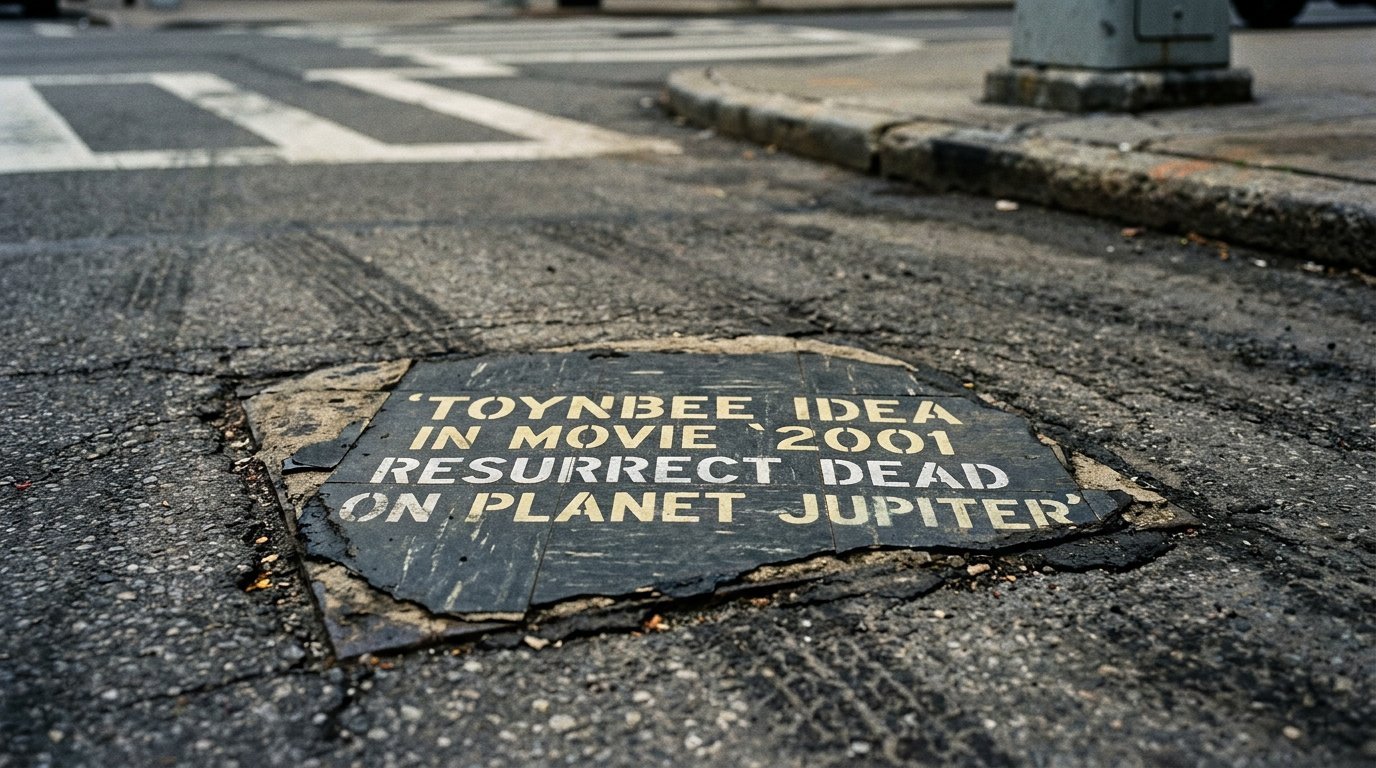
What Are We Even Looking At?
Scattered across roughly two dozen U.S. cities, plus a few spots in South America, are small, license-plate-sized tiles embedded directly into the asphalt. They're made of layered linoleum and some kind of asphalt crack sealant, tough enough to survive decades of traffic, snowplows, and repaving crews. Most carry a version of the same cryptic message:
TOYNBEE IDEA IN MOVIE `2001 RESURRECT DEAD ON PLANET JUPITER
That's it. That's the entire message, over and over, embedded into pavement in Philadelphia, Pittsburgh, Cleveland, St. Louis, Cincinnati, Chicago, Boston, Kansas City, New York, Washington D.C., and beyond. Estimates run into the hundreds, and nobody knows exactly how many exist today. People have discovered, destroyed through road work, and rediscovered them for over 40 years.
Okay, But What Does It Mean?
Each piece of the message points somewhere real, which is part of what makes this so fun to unpack. Arnold Toynbee was a real British historian who wrote about civilizations and, in passing, humanity's fascination with resurrecting the dead. "MOVIE `2001" is almost certainly a reference to Stanley Kubrick's 2001: A Space Odyssey, which flirts with themes of transformation and rebirth among the stars. The tile creators, when viewed together, seem to have established their own personal cosmology: they thought that the dead could, and should, be resurrected on Jupiter, and that this idea needed to be pushed into the mainstream by any means necessary, including illegally redecorating city streets.
Some of the more elaborate tiles go further, with bitter side text ranting about the media, the FBI, and journalists who'd apparently ignored the tiler's attempts to get the word out through normal channels like letters to newspapers. It reads less like street art and more like someone's private manifesto that escaped onto public infrastructure.
The Part That Makes This Actually Mysterious
Here's the real hook: nobody has ever installed a tile in front of witnesses. Since these tiles embed directly into the street surface, whoever installs them must work in traffic, likely at night. They must use a method that has evaded camera capture or that people have never fully explained. Theories have ranged from a tar-and-asphalt sandwich technique to, more colorfully, a hole cut into the floor of a car that lets the tiler drop tiles while driving over hot-patched asphalt.
A trio of Philadelphia investigators, Justin Duerr, Colin Smith, and Steve Weinik, spent roughly six years chasing this down and turned their findings into the 2011 documentary Resurrect Dead: The Mystery of the Toynbee Tiles, which premiered at Sundance. Investigators' most significant clue directed their attention toward Severino "Sevy" Verna, a reclusive individual from South Philadelphia. Three pieces of evidence linked him to the case: a newspaper clipping from 1983, a play that referenced the Toynbee idea, and a home address found on a tile discovered in Chile. Verna's neighborhood was littered with small "test" tiles, and some believed he'd removed the passenger seat from his car to make room for whatever his installation method required.
When the filmmakers finally tracked Verna down and asked him directly, he denied any involvement. And that's where it's sat ever since. Until someone confesses and definitively establishes the individual's identity, this case will remain without a definitive conclusion or closure. Just a trail of clues that all point toward one man who says it wasn't him.
Why This One's Worth a Post
Most street art has an artist who eventually takes a bow. The Toynbee Tiler never has, despite four decades of tiles, a Sundance documentary, amateur online sleuthing forums, and a very specific, very consistent obsession playing out in public infrastructure across two continents. It's a mystery you can go visit yourself; there are still tiles embedded in Philadelphia and Pittsburgh streets today if you know where to look.
The unanswered question isn't really "who did it," since the evidence points pretty hard in one direction. It's "why," and more specifically, why someone would go to these lengths, for this long, to plant a message about resurrecting the dead on Jupiter into the middle of a crosswalk, and then deny it when finally asked.
Sources for further reading: